What should the product brief define?
Start with the exact application, fit reference or controlled data, required access and protection zones, mounting method, target user, order quantities, destination market and launch timing. Add material, color, hardware, branding and packaging preferences without treating early preferences as final production approval.
The OEM development path
| Stage | Buyer input | Release evidence |
|---|---|---|
| 1. Feasibility | Application, reference, quantity and target date | Scope, assumptions and open questions |
| 2. Design definition | Coverage, access, retention and mounting priorities | Controlled geometry and bill-of-material direction |
| 3. Prototype | Review against intended configuration | Documented corrections and sample revision |
| 4. First article | Approval criteria and packaging data | Approved sample and release package |
| 5. Pilot lot | Limited production quantity | Process, assembly and pack-out verification |
| 6. Repeat supply | Current revision, forecast and destination | Lot records and change control |
Which product elements are configurable?
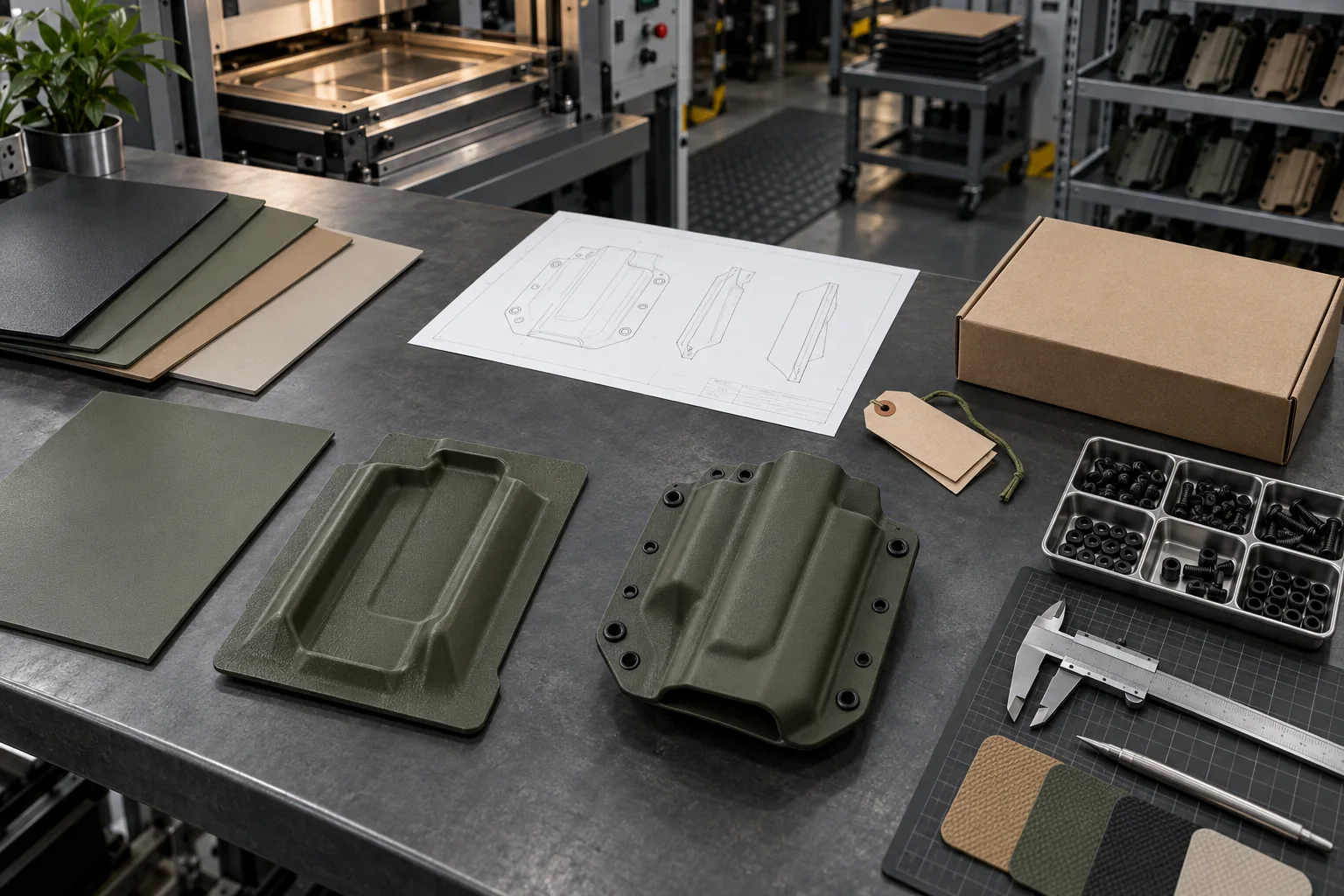
Formed shell
Material manufacturer and grade, nominal thickness, color, texture, coverage, openings, edge geometry and drainage.
Mounting system
Belt clips, loops, paddles, MOLLE, hook-and-loop or a controlled adapter family with defined positions.
Hardware and retention
Eyelets, posts, screws, spacers, adjustment range, locking method and internal clearances.
Private label
Approved marking, packaging artwork, SKU data, instructions, service kits and carton configuration.
How should quotations be compared?
Compare the same released scope. Separate development, tooling or fixture work from prototypes, pilot quantities and repeat-production pricing. Confirm whether hardware, packaging, inspection, export packing and freight are included, and identify the assumptions that can change MOQ or lead time.
What prevents problems on repeat orders?
Keep the product specification, bill of materials, golden sample, artwork and inspection plan under one revision system. A material, fit reference, hole pattern, hardware or packaging substitution should receive documented review before it inherits approval. Reconfirm availability, quantity, destination and current revision at every reorder.
Build the release package with the quality-control page, golden-sample guide, materials options, hardware specification and MOQ and landed-cost guide.
Frequently asked questions
Can an OEM program begin without finished CAD?
Yes. A controlled physical reference, dimensional brief and clear functional requirements can begin feasibility work; the required production data can then be defined during development.
Is a prototype the same as a released production sample?
No. A prototype explores and corrects the design. Production release requires an identified approval version with agreed materials, hardware, function, appearance and packaging.
Can one project include a family of carriers and mounting options?
Yes. Shared materials, hardware and interface patterns can be planned as a family, while each materially different configuration retains its own approval basis.
Validate the complete bonded or fastened joint
Use the OEM joining-method guide to connect substrate identity, surface preparation or hardware stack, production controls, load direction and change triggers.
Start repeatability before the sheet reaches the former
Use the material receiving and storage guide to define incoming evidence, segregation, preservation and reapproval triggers for OEM production.
Select the post-forming trim route from geometry and volume
The CNC, punching and fixture-guided trimming guide connects formed-part datums, feature complexity, revision risk, dedicated tooling and inspection evidence.
Control heating, forming readiness and cooling as one process window
The KYDEX thermoforming process-window guide shows how material identity, core and surface heating, tool condition, cooling and demolding evidence support repeat orders.
Choose the forming route from the released design
Vacuum and pressure forming offer different detail, texture and tooling capabilities. Use the vacuum-versus-pressure-forming buyer guide to connect geometry and appearance requirements to tooling, first-article evidence and change control.
Release the thermoforming tool as controlled engineering
Male/female tool choice, draft, radii, vents, undercuts and shrinkage allowance affect the approved formed result. Use the KYDEX thermoforming tooling design guide to connect CAD, first-article measurements and tool revisions.
Release inspectable geometry before repeat production
The OEM drawing and tolerance guide connects CAD, datum strategy, trim features, fixtures, measurement conditions and change control.
Review the complete KYDEX thermoforming capability
The KYDEX thermoforming capability page connects material, tooling, forming route, formed-wall requirements, trimming, assembly and production approval to the product brief.
Convert your product brief into a controlled OEM program.
Share the application, target quantity and launch requirements. We will outline the most practical sampling path.