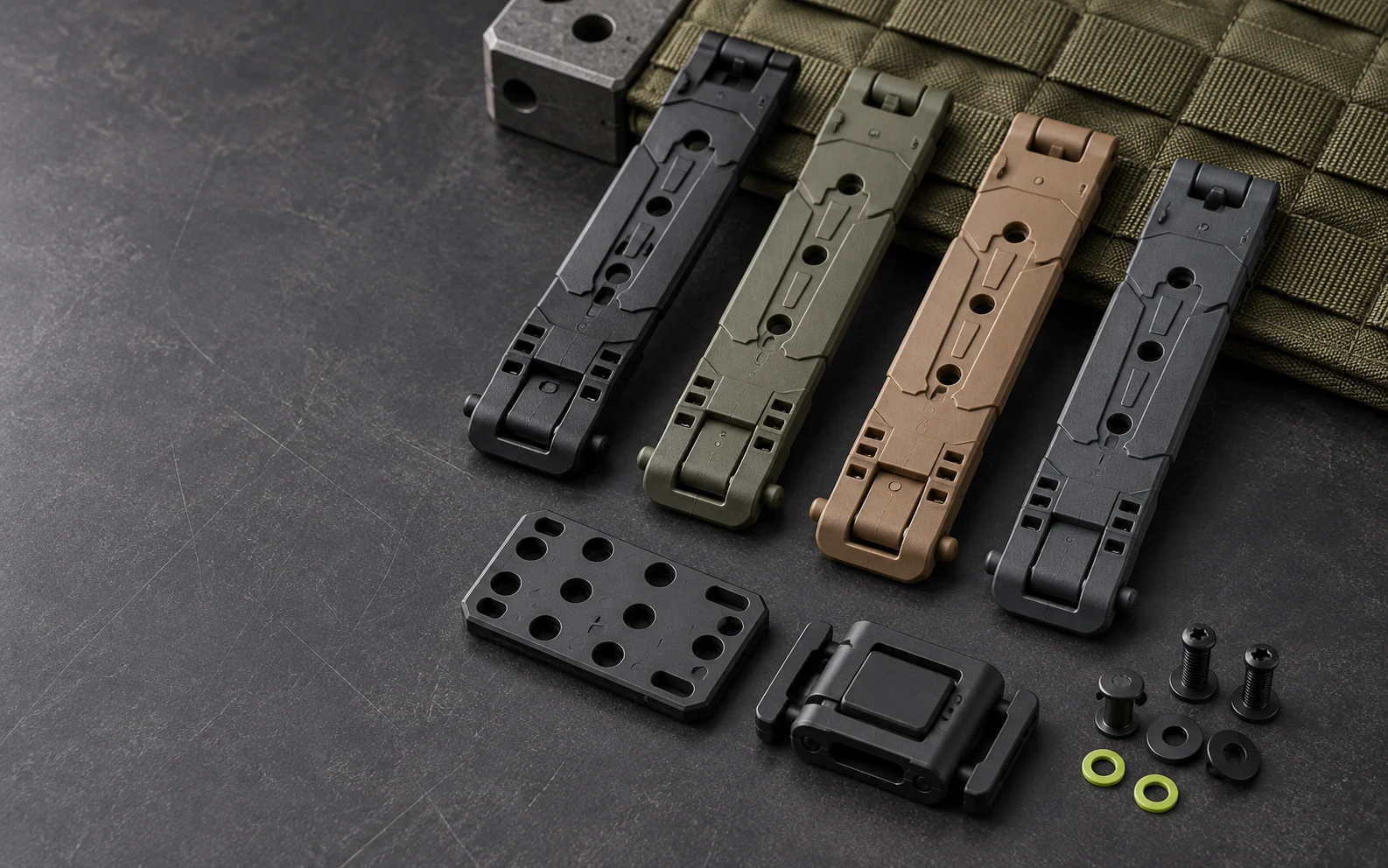
MOLLE and modular mounting components
Attachment bars
Elongated polymer bars can be developed around the nominated row spacing, installation direction and removal method.
Adapter plates
Multi-hole plates connect a molded carrier to a controlled family of belt, MOLLE or fixed-location interfaces.
Quick-change interfaces
Modular receivers require positive engagement, anti-rotation control and clear inspection criteria.
Mounting specification matrix
| Input | Define | Verify on sample |
|---|---|---|
| Host platform | Webbing geometry and material stack | Insertion, seating and removal |
| Footprint | Occupied columns and rows | Adjacent-pouch clearance |
| Orientation | Allowed vertical or angled positions | Rotation under representative load |
| Service | Tool and replacement requirements | Fastener access and inspection |
System validation before repeat production
The molded carrier, adapter and host platform act as one assembly. Test the intended equipment mass, user movement, installation cycles and environmental expectations on the actual vest, panel, pack or belt named in the program.
See the MOLLE OEM platform guide, MOLLE product development and mounting platform concept.
Frequently asked questions
Is MOLLE compatibility universal?
No. Webbing dimensions, stack-up and panel stiffness vary, so representative host equipment should be approved.
Can one carrier move between belt and MOLLE use?
A common carrier may support controlled adapters when its interface and fastener stack are engineered as a system.
Can mounting orientation be adjusted?
Defined positions can be developed, provided engagement and anti-rotation behavior are validated.
Define the host platform before choosing the adapter.
Share the application, target quantity and launch requirements. We will outline the most practical sampling path.