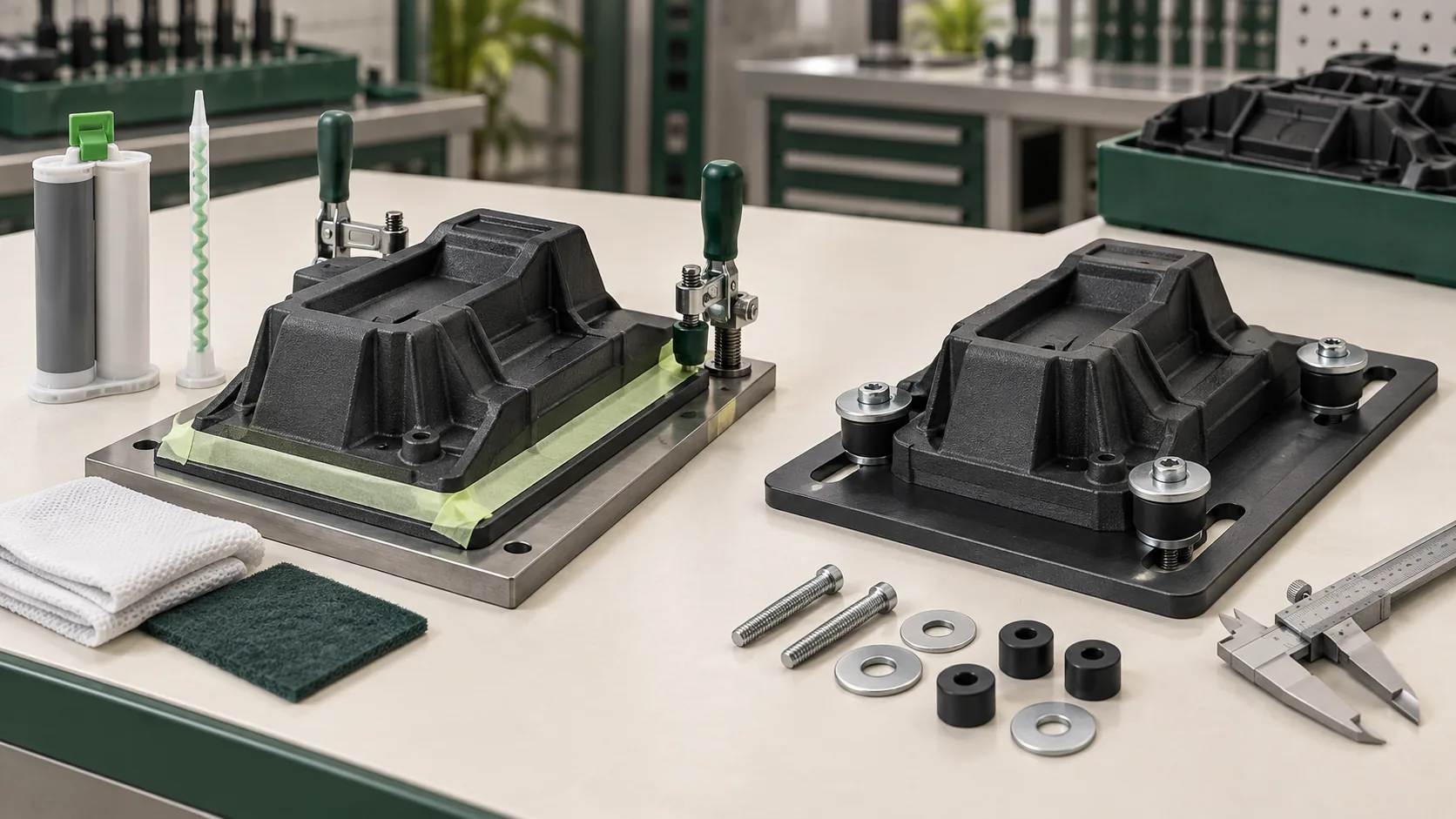
What is the difference between bonding and mechanical fastening?
Bonding transfers load through an adhesive or solvent-cemented interface. Mechanical fastening transfers load through screws, posts, rivets, washers, slots or other hardware. SEKISUI KYDEX notes that its sheet can be joined to itself or other materials by either route. The buyer’s decision should include how the product will be assembled, inspected, serviced and changed after launch.
Joining-method comparison for OEM buyers
| Decision | Bonded joint | Mechanical joint |
|---|---|---|
| Appearance | Can hide hardware and distribute the interface | Visible heads or posts may become design features |
| Serviceability | Often intended as permanent; repair method must be defined | Can allow adjustment, replacement or disassembly when designed for it |
| Process control | Surface preparation, mix, dispense, open time, pressure and cure | Hole/slot geometry, stack, engagement, torque or setting force |
| Mixed substrates | Adhesive must match both surfaces and the environment | Thermal expansion and bearing load need allowance |
| Inspection | Bond-line condition and validated destructive or witness testing | Installed stack, alignment, setting and functional checks |
What does the material supplier say about bonding?
The supplier’s Bonding KYDEX Sheet TB 150A explains that the material’s chemical resistance can make cementing more demanding than some plastics, while strong bonds are possible with appropriate methods. It discusses KYDEX-to-KYDEX and mixed substrates including plastics, metal and wood. The brief also emphasizes clean, grease-free and dust-free surfaces for metal and wood bonding and refers users to the selected adhesive manufacturer’s directions.
Why should old adhesive names not become a frozen purchase specification?
Supplier technical briefs may list example chemistries or trade products, but availability and formulations can change. A production specification should identify the currently approved adhesive, manufacturer data revision, substrates, preparation, dispense and cure process, instead of copying a historical product name without confirmation. Solvent-based systems also require a documented workplace-safety and environmental review outside the scope of a product page.
What changes when KYDEX is fastened to another material?
SEKISUI KYDEX’s Mechanical Fastening KYDEX Sheet TB 151A says designers should consider differential thermal expansion when rigid fasteners join KYDEX to another material. The bulletin describes oversized holes as one allowance and recommends washers or large-headed fasteners for higher-stress sheet assemblies. It also warns against high rivet tension. These are design inputs, not automatic dimensions for every small carry product.
How should load be distributed around a fastener?
A small head or excessive clamp force can concentrate stress at a hole. The released design should control edge distance, washer or flange diameter, local wall thickness, spacer compliance, slot direction and the expected load path. Use the separate hardware fastener-stack guide to document posts, screws, washers, spacers, engagement and bottoming; this article focuses on choosing the joint architecture.
Joint validation plan
| Evidence | Bonded assembly | Mechanically fastened assembly |
|---|---|---|
| Input identity | Substrates, adhesive lot and shelf-life status | Substrates, hardware and elastomer lots |
| Process record | Preparation, mix/dispense, time, pressure and cure | Hole/slot revision, stack order and setting method |
| Initial inspection | Coverage, squeeze-out, gap and alignment | Seating, engagement, clearance and free movement |
| Functional exposure | Representative peel/shear/load direction and environment | Representative pull-through, rotation, loosening and environment |
| Change trigger | Adhesive, substrate, preparation, cure or supplier change | Hardware, hole, washer, spacer, setting or substrate change |
Can one assembly use both methods?
Yes, when each element has a defined job. An adhesive may stabilize a broad interface while fasteners provide a serviceable attachment or controlled clamp. A hybrid design should not assume both routes automatically create double strength; stiffness changes can move stress into a local edge, hole or bond termination. Validate the combined load path rather than testing each component in isolation.
Where does joining fit in the OEM release file?
Record the joint on the drawing and bill of materials, then connect it to the first-article inspection, approved sample, quality plan and manufacturing workflow. Product-specific pages such as the hybrid IWB assembly and vehicle/desk mount can then reference a controlled connection instead of a vague “attached backer” requirement.
Frequently asked questions
Is adhesive bonding always stronger than screws or rivets?
No. Strength depends on substrate preparation, joint geometry, chemistry, cure, load direction and environment; mechanical performance likewise depends on geometry and the complete installed stack.
Are oversized holes required for every KYDEX fastener?
No universal rule should be copied into every small assembly. The supplier raises differential thermal expansion for rigid mixed-material joints; the necessary allowance depends on size, materials, constraint and exposure.
Can a bonded assembly be repaired in the field?
Only if a repair method has been validated and documented. Permanent joints may instead require component or assembly replacement.
What should trigger revalidation?
Changes to substrates, adhesive or hardware, preparation, hole geometry, cure or setting process, load path, environment, supplier or appearance requirement should be reviewed.
Release the joint as an engineered part of the product.
Share the application, target quantity and launch requirements. We will outline the most practical sampling path.