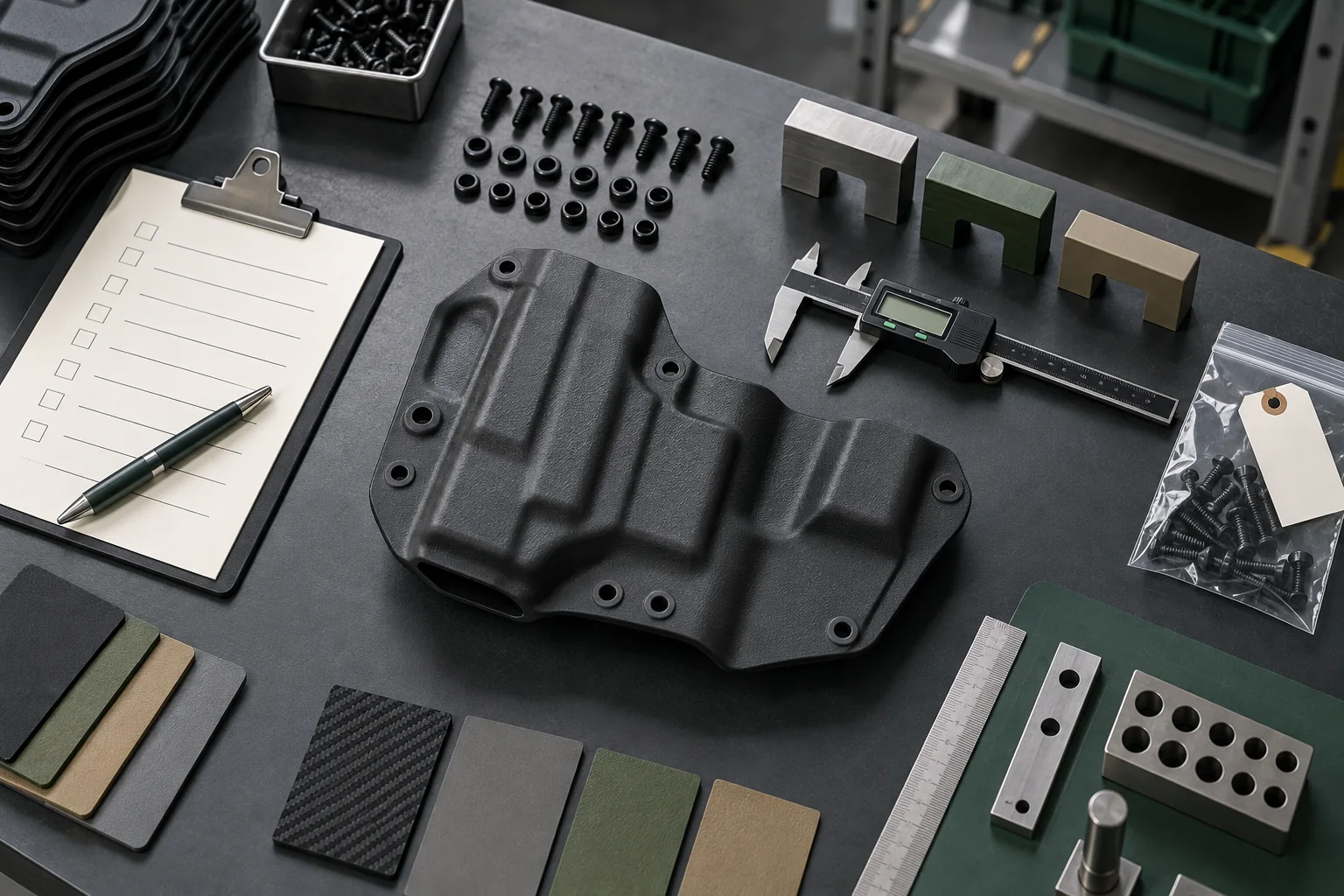
What defines an acceptable product?
An approved sample is useful only when it is connected to controlled documents. The release package should identify the fit reference, material manufacturer and grade, nominal thickness, color and texture, formed geometry, edge standard, hole pattern, hardware stack, mounting positions, retention behavior, markings, included parts and packaging revision.
Quality checkpoints from development to shipment
| Stage | Control | Typical evidence |
|---|---|---|
| Incoming material | Grade, thickness, color, texture and lot | Receiving record and supplier identification |
| First article | Fit, dimensions, openings, hole pattern and appearance | Measured sample and approval record |
| In-process | Heating, forming detail, trim and edge condition | Defined checks at controlled intervals |
| Assembly | Hardware, orientation, clearances and adjustment | Bill-of-material and functional verification |
| Final pack-out | SKU, quantity, labels, accessories and protection | Lot and packing record |
Which characteristics deserve explicit limits?
Prioritize characteristics that affect fit, access, mounting and repeat use. Examples include seating depth, protected clearances, retention range, hole location, edge distance, fastener engagement, installed movement, permitted cosmetic marks and package contents. A generic “good quality” instruction cannot replace measurable or observable acceptance criteria.
How are revisions and substitutions controlled?
A change to the fit reference, sheet grade, forming tool, trim path, hole pattern, hardware, artwork or packaging can affect the released result. Record the proposed change, identify which checks are affected and approve a revised first article or golden sample when required. Unapproved substitutions should not inherit prior approval automatically.
What should an OEM buyer request?
- A revision-controlled product specification and bill of materials
- An identified golden sample or first-article approval basis
- Critical-to-quality checks with method and acceptance rule
- A defect classification or visual standard where appearance matters
- Traceable lot and packing records appropriate to the program
- A documented response for nonconforming product and approved changes
Use the golden-sample approval guide, thermoforming defect and inspection guide, materials specification page and OEM manufacturing workflow to prepare your program.
Frequently asked questions
Does CarryMold use one inspection plan for every product?
No. Inspection points and sampling expectations should follow the product configuration, risk, quantity and written buyer requirements.
Can photographs replace an approved physical sample?
Photographs help record appearance and configuration, but they may not establish fit, stiffness, edge feel or retention. Use them as supporting evidence.
Should packaging be included in quality approval?
Yes. SKU labels, instructions, included hardware, abrasion protection, quantities and artwork revision are part of the sellable configuration.
Inspect formed appearance by cosmetic zone
Use the formed-texture approval guide to define primary surfaces, stretch-sensitive transitions, physical comparators, viewing conditions and reapproval triggers.
Pair the edge standard with a controlled trimming process
Use the post-forming trimming process guide to release fixture datums, CNC program or punch identity, tool condition and first-article measurements.
Control the final trim and contact edges
Formed surfaces are only one part of the released product. Use the KYDEX trimming and edge-finish quality guide to define outlines, holes, slots, burr limits, user-contact zones and approval evidence.
Trace defects back to controlled tooling evidence
Draft, radii, vacuum vents, undercuts and repair history can affect detail, release and repeatability. The OEM tooling design guide outlines what to identify on drawings, first articles and change records.
Make the drawing and inspection method agree
Use the thermoformed-part drawing and tolerance guide to define functional datums, tool and non-tool surfaces, critical dimensions, measurement state and first-article evidence.
Release fit and retention with a repeatable method
Use the OEM functional and retention validation guide to define the configured sample, pull method, mounting interface, cycle checks, acceptance window and reapproval triggers.
Turn product expectations into an inspection-ready release package.
Share the application, target quantity and launch requirements. We will outline the most practical sampling path.