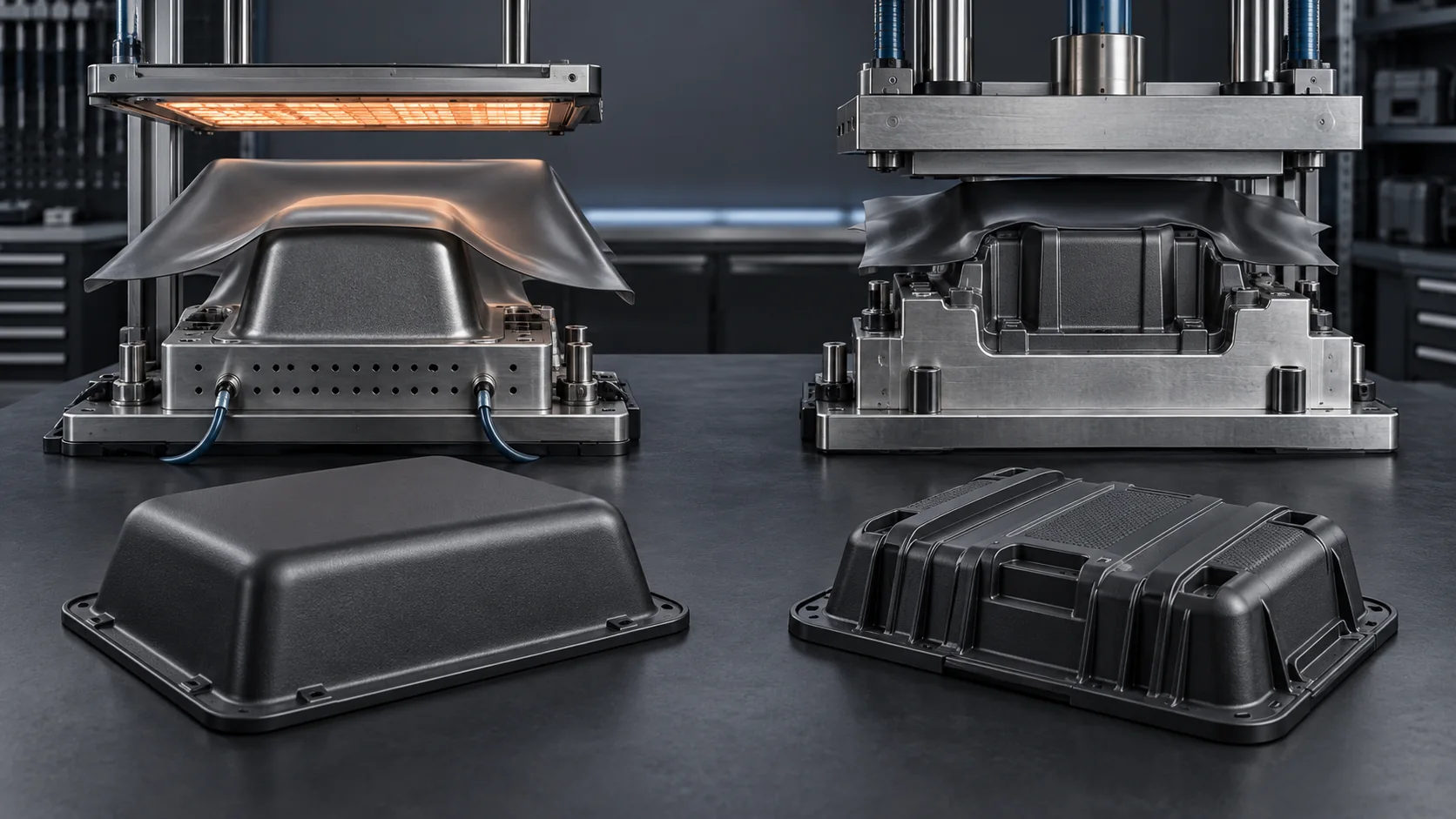
What is the difference?
Both processes heat a clamped thermoplastic sheet and use a pressure difference to make it conform to tooling. In vacuum forming, vacuum draws the sheet against a male or female tool. Pressure forming also applies compressed air above the sheet while vacuum acts between sheet and tool, increasing contact force in fine features. SEKISUI KYDEX describes vacuum, pressure and mechanical/plug-assist forming as distinct thermoforming methods in its Fundamentals of Thermoforming KYDEX sheet.
Buyer comparison
| Decision | Vacuum forming | Pressure forming | What to approve |
|---|---|---|---|
| Geometry | Well suited to accessible contours and practical drafts | Can reproduce sharper detail and more complex tool-side features | Controlled CAD/drawing and physical sample |
| Surface | Commonly preserves the character of the supplied sheet, subject to stretch | Can reproduce texture from the contacting tool surface | Named color/texture reference and viewing conditions |
| Wall distribution | Depends on draw, tool side, heating and any pre-stretch or plug assist | Still geometry-dependent; higher contact force does not remove the need to measure critical areas | Starting gauge plus critical formed-wall locations |
| Tooling | May support a simpler development path for suitable parts | Requires pressure-capable tooling and process control | Tool concept, revision and change triggers |
| Repeatability | Can be repeatable with controlled material, heating, tool and cooling | Can improve detail consistency for designs that need it | First article, golden sample and lot checks |
| Commercial fit | Choose when it meets the released part requirements | Choose when added detail justifies the added process/tooling needs | Quoted scope, volume and validation plan |
When should an OEM buyer consider pressure forming?
Consider it when the design depends on tool-side textures, crisp ribs or recesses, tight feature definition, selected undercuts using suitable tooling, or close mating relationships. SEKISUI KYDEX notes that pressure forming can create sharper details, in-mold texture and undercuts, while its thermoforming process overview also emphasizes that the tooling and part design determine the result. These are process capabilities, not automatic guarantees for an unspecified carry product.
When can vacuum forming be the better sourcing choice?
Use vacuum forming when the geometry, surface target, functional clearances and volume can be achieved and validated without the extra pressure-forming architecture. Simpler does not mean uncontrolled: sheet identity, heating uniformity, tool temperature, vacuum delivery, cooling, trimming and assembly still need a released process. The best commercial decision is the least complex process that repeatedly passes the agreed product specification.
Male tool or female tool?
Tool side changes where the sheet first contacts the surface, how material is distributed and which face carries the most direct tool definition. A male tool forms the sheet over an external shape; a female tool draws or presses it into a cavity. The choice affects draft, release, wall distribution, cosmetic side and feature reproduction. Buyers should approve the intended cosmetic surface and critical measurement locations rather than infer them from the process name.
Tooling and change-control questions
- Which surface contacts the tool and which surface is cosmetic?
- Is the tool male, female, articulated or used with plug assist?
- Which radii, recesses, textures and undercuts are functionally critical?
- Where will formed-wall thickness be measured?
- What draft and release method are required?
- Which tool revision produced the approved sample?
- What changes require a new first article?
Common defects are not diagnosed by process name alone
Poor detail, uneven wall distribution, scorching, discoloration, sticking and tearing can be connected to heating, vacuum, pressure, cooling, draft, radii or tool layout. SEKISUI KYDEX’s thermoforming troubleshooting brief maps symptoms to multiple possible causes. A useful supplier corrective action therefore records the observed location, material lot, tool revision, machine settings and inspection evidence instead of changing one variable by guesswork.
Approval package for either process
Design evidence
Released geometry, datums, critical features, surface zones and allowed configurations.
Material evidence
Approved grade, color, texture, starting gauge and traceable substitution rules.
Process evidence
Tool revision, forming route, critical setup controls and documented change triggers.
Product evidence
First article, formed-wall checks, trim/assembly inspection and approved functional tests.
Connect the process decision to the full OEM specification
Compare the process against the formed-wall thickness guide, color and texture approval guide, thermoforming defect guide, first-article checklist, quality framework and OEM development workflow.
Frequently asked questions
Is pressure forming always higher quality than vacuum forming?
No. Quality means conformity to the released requirement. Pressure forming adds useful capabilities, but vacuum forming can be the correct controlled process for a suitable design.
Does pressure forming prevent wall thinning?
No. Geometry, tool side, draw ratio, heating, pre-stretch, plug assist and process settings still affect material distribution. Measure critical formed areas on the approved part.
Can a vacuum-formed design move to pressure forming without reapproval?
Not safely by assumption. A process or tooling change can alter surface, dimensions, wall distribution, shrinkage and assembly relationships, so affected requirements should be revalidated.
Which method is cheaper?
There is no responsible universal answer. Tool construction, part geometry, detail, volume, cycle, trimming, inspection and change risk all affect quoted cost.
Choose the forming route from the released product requirements.
Share the application, target quantity and launch requirements. We will outline the most practical sampling path.