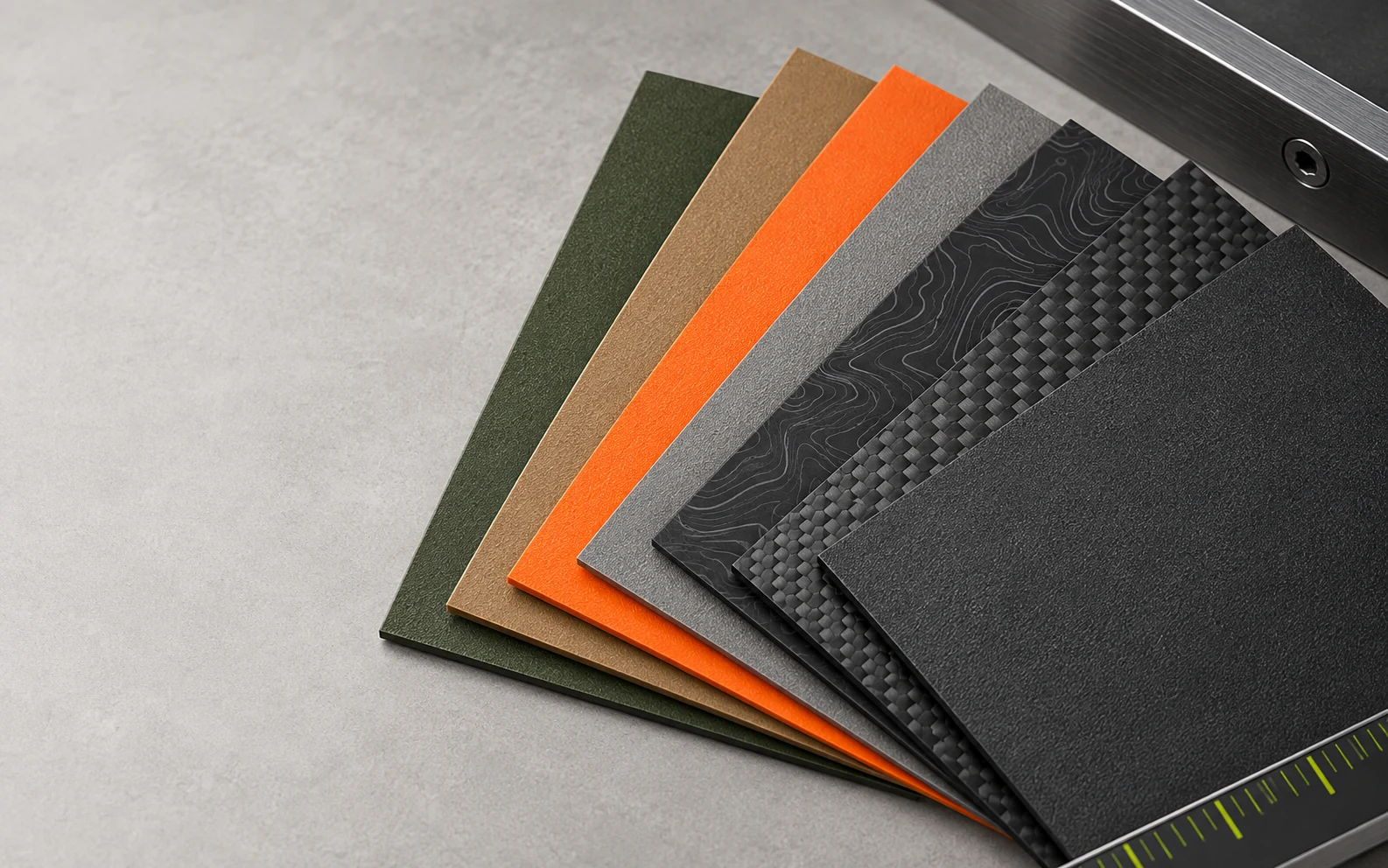
Thermoplastic sheet options for molded carry products
Material selection affects forming behavior, stiffness, edge finishing, color consistency and the finished product’s appearance. Buyers should specify the application and acceptance criteria—not simply choose a color from a photograph.
Solid colors
Graphite, black, coyote, olive, gray and program-specific accent colors can be evaluated against minimum order and lot consistency requirements.
Surface textures
Fine haircell, matte and selected decorative surfaces can be reviewed on physical samples because lighting and forming depth change their appearance.
Thickness
Nominal thickness, tolerance and the formed-part result should be recorded in the approved specification.
Buyer specification checklist
| Decision | What to provide | What we confirm |
|---|---|---|
| Material identity | Required brand or performance target | Available manufacturer and exact grade |
| Appearance | Color reference, texture and gloss | Sample and lot-control method |
| Part behavior | Application, load and environment | Thickness and forming proposal |
Material naming and verification
KYDEX® is a registered trademark of SEKISUI KYDEX, LLC. Marketplace descriptions such as “Kydex,” “K board” or “thermoplastic sheet” do not by themselves prove the sheet manufacturer or grade. CarryMold records verified material identity in the quotation and bill of materials when branded material is required.
See our Kydex sheet sourcing guide and OEM manufacturing process.
Frequently asked questions
Can I select a custom color?
Yes, subject to material availability, minimum quantity, color tolerance and sample approval.
Is every black thermoplastic sheet KYDEX?
No. KYDEX is a trademarked material family. The exact manufacturer and grade must be verified.
Should texture be approved before production?
Yes. Approve a formed sample because heat and geometry can change the visible surface.
Specify the formed result
Nominal sheet gauge does not remain uniform across every formed surface. Use the KYDEX sheet thickness and formed-wall guide to define critical measurement areas, approval evidence and change controls alongside material grade, color and texture.
Separate material appearance from applied branding
Use the private-label decoration guide to distinguish integral sheet color and texture from embedded imaging, surface coatings and separately attached identity components.
Approve texture after it follows the formed geometry
The KYDEX texture-stretch guide explains how sheet texture, draw depth, orientation, cosmetic zones and cleaning requirements should be reviewed on a production-representative formed sample.
Carry the material specification through receiving and storage
The KYDEX incoming-inspection and storage guide connects grade, gauge, color, texture, surface condition and lot identity to production release.
Separate recyclability from verified recycled content
The KYDEX recycling and environmental-claims guide shows how material identity, local recovery routes, scrap segregation and claim evidence should remain distinct.
Release cleaning instructions with the material specification
The KYDEX product cleaning and chemical-compatibility guide shows how to connect grade and texture identity to routine care, named exposures, assembly-level checks and customer instructions.
Connect material identity to the validated forming window
Grade and gauge affect heating and forming behavior. Use the OEM process-window guide to document supplier guidance, production readiness, cooling and repeat-order change controls.
Carry the material specification through thermoforming
Grade, gauge, color and texture must remain connected to tooling, forming, trim and approval evidence. Review the custom KYDEX thermoforming capability before releasing a finished-product program.
Start with what KYDEX material actually specifies
The What Is KYDEX material guide separates the material family from grade, gauge, color, texture, formed-wall requirements and finished-product approval.
Choose gauge for the finished carry product
Color and texture do not determine shell stiffness. Compare 0.060, 0.080 and 0.093 inch KYDEX holster thickness against geometry, draw depth, mounting load and the approved formed sample.
Define the material before tooling and sampling.
Share the application, target quantity and launch requirements. We will outline the most practical sampling path.