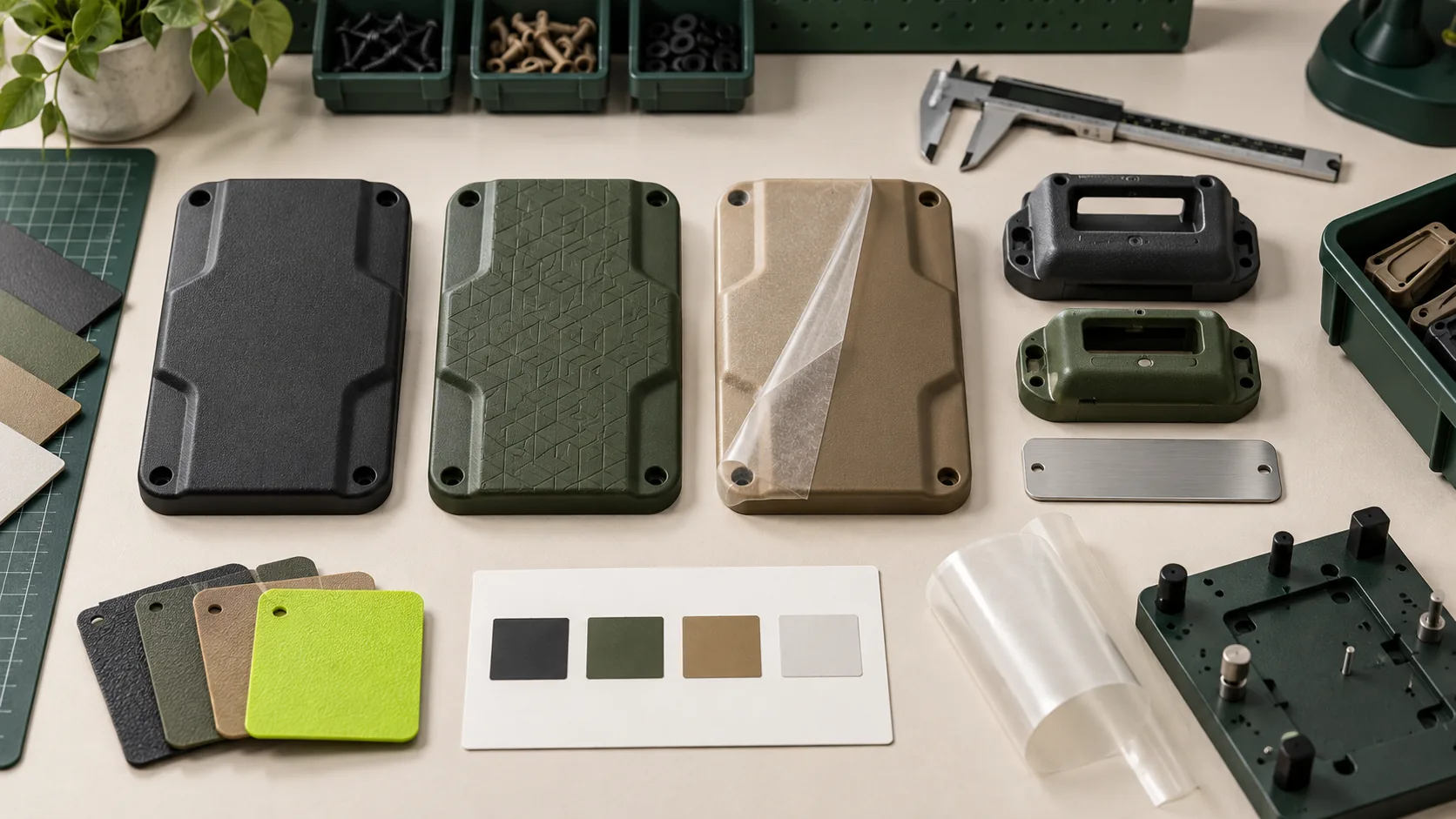
What counts as branding on a molded product?
Brand identity can come from the base sheet color and texture, a pattern integrated into the material, a coating or printed surface, a formed-in feature, or a separately attached label, badge or packaging element. Each route changes what the buyer must control. CarryMold confirms available methods during quotation; this guide is a specification framework, not a promise that every decoration can be applied to every product.
Brand-decoration decision map
| Route | Useful when | Approval focus |
|---|---|---|
| Integral sheet color/texture | The material itself should carry the primary appearance | Grade, physical color standard, texture, lot boundary and formed appearance |
| Embedded or supplier-integrated pattern | A repeat graphic should be part of a qualified decorative sheet | Rights, scale, orientation, crop, sheet construction and forming result |
| Surface coating or paint | A qualified surface finish is needed after forming or preparation | Paint system, preparation, color, adhesion, cure, wear and regulatory limits |
| Label, badge or plate | Identity should be applied as a separate controlled component | Material, artwork, attachment, location, edges, environment and replacement |
| Packaging-only identity | The product remains visually neutral while the sellable SKU is branded | Artwork, barcode, market copy, included parts and pack-out revision |
How is integral color different from a surface finish?
Integral color belongs to the sheet specification; a coating is a secondary process on the surface. The color and texture approval guide explains why screen appearance is not a production reference. A coating adds its own preparation, adhesion, cure, appearance and exposure controls. Buyers should not approve the two routes from the same digital image alone.
What does the material supplier say about painting?
SEKISUI KYDEX’s Painting KYDEX Thermoplastic Sheet TB 152A says the material’s chemical resistance means paint selection matters. It discusses recommended paint systems, surface preparation, forming heat and adhesion, and notes that environmental rules can affect allowable VOC levels. An OEM file should therefore identify the current paint manufacturer data, preparation and cure process, not merely call for a color.
What is embedded imaging?
SEKISUI KYDEX describes Infused Imaging as its proprietary method for integrating custom design into KYDEX sheet rather than adding a conventional image only on the surface. Its design questions include copyright permission, orientation and scale. Because it is a named supplier technology, availability, applicable grade, minimums and lead time must be confirmed; CarryMold does not use the term as a generic synonym for printing.
Artwork approval checklist
| Control | What to release |
|---|---|
| Rights | Written authorization for logos, artwork, licensed patterns and compatibility references |
| Source file | Approved vector/raster format, color space, version and responsible owner |
| Placement | Datum, orientation, visible zone, permitted crop and keep-out areas |
| Color | Physical standard or signed sample plus viewing conditions and acceptable variation |
| Surface result | Gloss, texture, edge transition, pinholes, overspray or label-edge criteria as relevant |
| Exposure | Cleaning, abrasion, flex, temperature, moisture or UV checks tied to intended use |
| Change control | Approval trigger for material, supplier, artwork, process, location or finish revision |
How should a brand approve a patterned formed part?
Review the pattern on a production-representative formed and trimmed sample, not only on a flat sheet. Geometry can change visible scale, direction and crop; holes, slots and fasteners can interrupt artwork. Define which surfaces are cosmetic, where registration matters and how parts from different SKUs should align visually. Retain a signed physical reference with the artwork revision.
Where should labels and badges be controlled?
Treat them as bill-of-material components. Record substrate, print, dimensions, corner condition, attachment method, placement datum and environmental limits. If adhesive-backed, connect the interface to the joining-method guide. If hardware-mounted, release the complete fastener stack. Customer-facing packaging and barcode identity belong in the separate packaging and SKU approval guide.
How does branding enter the OEM workflow?
Include the chosen route, target appearance, rights status, quantity by SKU and market destination in the RFQ brief. Review feasibility before final artwork production; then approve a first article and retain the released result through the golden-sample process. Recheck the final private-label program when materials, decoration suppliers or artwork change.
Frequently asked questions
Can any logo be printed directly on KYDEX?
No universal method should be assumed. The material grade, surface, geometry, artwork and required durability determine whether a coating, embedded process, label, badge or packaging-only route is appropriate.
Does a digital proof approve production color?
No. It can approve layout, but production color should use a defined physical reference and representative sample under agreed viewing conditions.
Can CarryMold use a marketplace image as artwork?
Only buyer-owned or properly licensed assets should enter an OEM program. A public image is not evidence of reproduction rights.
Should branding be retested after a material change?
Yes, when the change can affect color, texture, adhesion, forming appearance, label attachment or environmental performance.
Turn brand artwork into a controlled production specification.
Share the application, target quantity and launch requirements. We will outline the most practical sampling path.