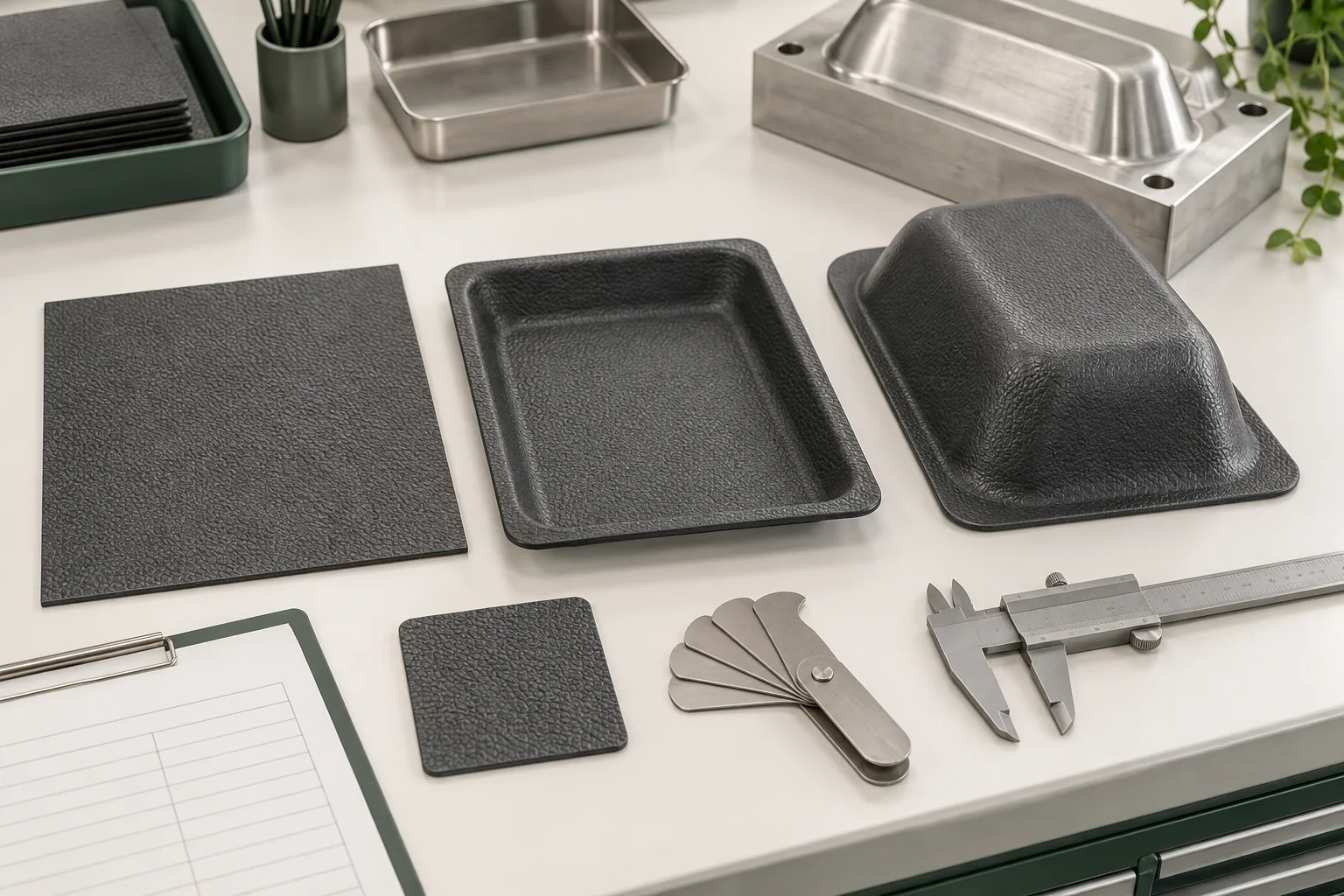
Why can a KYDEX texture look different after forming?
Thermoforming enlarges the sheet surface over three-dimensional geometry. A texture created on the sheet before forming travels with that surface: it may become longer, shallower or less uniform where the material stretches most. The result is not adequately predicted by viewing an online swatch. Buyers should connect appearance approval to the actual grade, gauge, texture, tool, forming route and part geometry.
Sheet texture and in-mold texture are different routes
| Route | How appearance is created | Main OEM approval question |
|---|---|---|
| Sheet-embossed texture | Texture is present before forming and stretches with the sheet | Where does the formed texture wash out, elongate or change gloss? |
| In-mold texture | A suitable forming process reproduces the tool surface on the part | Which face contacts the textured tool, and is the required detail feasible? |
| Integrated decorative pattern | Pattern and substrate are supplied as a qualified decorative material | How do scale, direction, crop and texture behave on the formed part? |
| Applied finish | A coating or separate surface process is added under its own specification | How are preparation, adhesion, cure, wear and color controlled? |
What does the material supplier say?
SEKISUI KYDEX explains in its Decorative Textures guidance that sheet texture distortion is proportional to draw ratio and tool geometry. Deeper draw can increase stretch and texture washout; enclosed valleys in deeper textures may also retain soil and require more cleaning. Its thermoforming fundamentals distinguish conventional vacuum forming from pressure forming, including the latter route’s ability to reproduce selected tool texture and detail. These are process-design inputs, not universal guarantees for every CarryMold program.
Texture approval map
| Control | What the buyer should release |
|---|---|
| Material identity | Manufacturer, grade, nominal gauge, color, texture code and approved substitutions |
| Orientation | Sheet direction, pattern direction, mirrored parts and permitted rotation |
| Cosmetic zones | Primary visible face, secondary face and areas where stretch or gloss shift is acceptable |
| Geometry | Deep draws, tight radii, transitions and trim lines requiring appearance review |
| Comparator | Signed formed sample, viewing distance, light condition and agreed range of variation |
| Care check | Approved cleaning method for valleys, corners and any applied decoration |
| Change trigger | Material lot/source, gauge, tool, process, orientation or finish revision requiring review |
How should a buyer define cosmetic zones?
Do not apply one vague “match texture” note to the whole part. Mark the customer-facing area, user-contact zones, hidden mounting face and high-draw transitions on a drawing or annotated sample. A primary cosmetic face may need consistent direction and definition, while a concealed flange can accept a broader appearance range if fit and strength remain approved.
Can tooling reduce texture distortion?
Geometry and material distribution matter. The supplier guidance discusses reducing unnecessary trim height, using more symmetrical tool design, pre-distributing material and splitting difficult geometry where appropriate. Those choices belong in the thermoforming tooling review and forming-route decision. They should be validated on the released part rather than treated as a guaranteed recipe.
How does texture affect color, branding and cleaning?
Texture changes how light reflects, so the same integral color may look different across a flat area and a stretched radius. Use the color and texture approval guide for physical color references. If artwork or a badge is involved, connect it to the branding and decoration specification. Deeper texture can also change soil removal, so release customer-care wording through the cleaning and chemical-compatibility guide.
What belongs in the first-article report?
Photograph the primary cosmetic faces under controlled light and compare the formed part with the signed reference. Record material identity, tool revision, orientation and any approved boundary sample. Dimensional and functional results remain separate checks: attractive texture does not approve fit, retention, mounting or edge quality. Link the evidence to the first-article checklist and retain the released visual result in the golden-sample file.
Frequently asked questions
Should the formed texture exactly match the flat sheet?
Not as a blanket rule. Sheet-embossed texture follows the stretched surface, so the approval should define the formed result and acceptable zone-specific variation.
Does a deeper texture always hide scratches better?
No universal performance claim should be inferred from appearance. Texture depth can also affect cleaning and should be tested for the intended product environment.
Can a digital photograph approve texture?
A photograph helps document location and gross defects, but lighting, focus and display settings change perceived gloss and relief. Use a retained physical formed sample when appearance is commercially important.
When should texture be reapproved?
Reapprove when a material source, grade, gauge, texture, orientation, tool, forming route or applied finish changes enough to affect the released appearance.
Approve texture on the formed product, not the flat swatch.
Share the application, target quantity and launch requirements. We will outline the most practical sampling path.