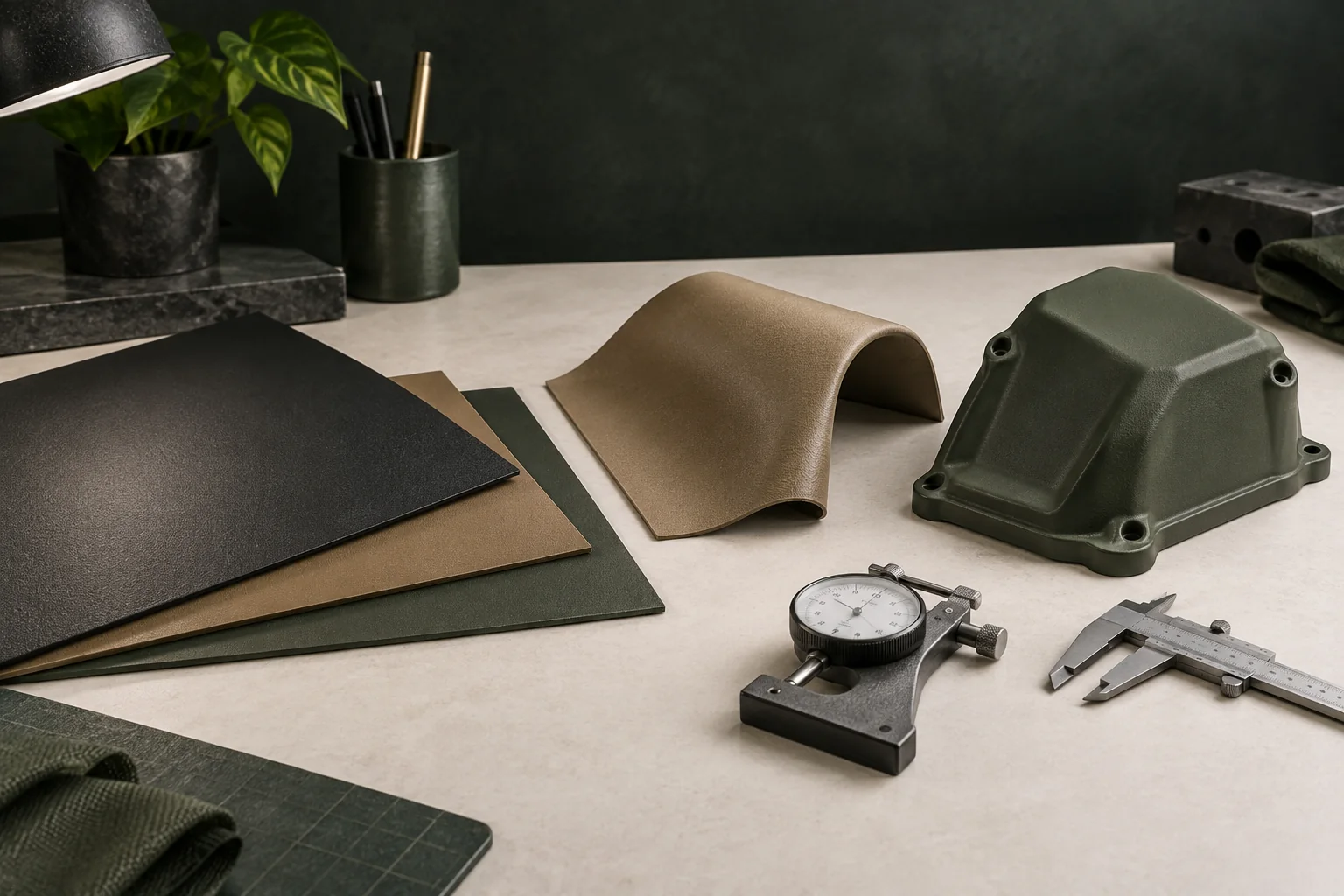
KYDEX is a family of proprietary thermoplastic sheet materials used to form durable housings, interior components and rigid carry products. For an OEM buyer, the useful question is not whether a supplier uses “plastic,” but which grade, nominal gauge, color, texture and forming specification will be released for the finished part.
Is KYDEX a plastic or a thermoplastic?
KYDEX is a thermoplastic sheet family. Thermoplastic means the material can soften when heated and retain a new form after controlled cooling. That behavior makes it suitable for repeatable formed shells, covers, carriers and enclosures. It does not mean every grade should use the same forming settings or that every sheet sold under a broad material description performs identically.
Buyers often search for KYDEX plastic, KYDEX thermoplastic, KYDEX sheet, KYDEX sheets, KYDEX sheeting or a sheet of KYDEX. These phrases describe related material intent, but a production specification still needs the exact manufacturer designation and released attributes.
What should a KYDEX material specification include?
| Specification field | Why it matters | Approval evidence |
|---|---|---|
| Manufacturer and grade | Separates a controlled material from a generic substitution | Supplier designation and purchasing record |
| Nominal sheet gauge | Affects stiffness, forming behavior and starting stock | Incoming check and released drawing |
| Color and texture | Appearance can change after forming and stretching | Flat swatch plus approved formed sample |
| Critical formed-wall zones | Nominal sheet thickness is not uniform after forming | Defined measurement locations and method |
| Change-control rule | Prevents silent grade, gauge or appearance changes | Revision record and reapproval trigger |
How does a flat KYDEX sheet become a finished product?
- Identify the stock. Confirm grade, gauge, color, texture, lot or traceability depth required by the program.
- Prepare tooling and reference geometry. Tool draft, radii, vents, undercuts and trim datums affect the formed result.
- Heat and form. Use a validated window tied to the actual sheet and equipment rather than a universal internet temperature.
- Cool and release. The part must retain geometry without premature distortion.
- Trim, drill and assemble. Edge quality, hole position, fastener stack and attachments become part of the finished specification.
- Inspect and approve. Compare the first article with drawings, functional checks and the approved sample.
Does CarryMold sell KYDEX sheet?
CarryMold develops and manufactures finished thermoformed products for OEM, ODM and private-label programs. The company does not position this website as a retail KYDEX sheet store. Buyers looking for finished holsters, sheaths, equipment carriers or mounts can use the material information to prepare a clearer product brief.
How should buyers compare KYDEX with Boltaron or another sheet?
Do not compare trade names in isolation. Compare the exact grade, gauge, forming route, appearance requirements, exposure conditions, functional loads and supplier documentation for the intended part. The KYDEX versus Boltaron guide explains the selection framework, while the sheet-sourcing guide covers purchasing identity and substitution control.
Frequently asked questions
What is KYDEX material used for?
It is used in thermoformed parts such as protective shells, housings, interior components, holsters, sheaths, equipment carriers and mounts. Suitability depends on the exact grade and released product requirements.
Is thicker KYDEX always better?
No. Starting gauge affects stiffness and forming, but geometry, draw depth, formed-wall distribution, attachment loads and product use must be considered together.
Can color or texture be approved from a flat sample?
A flat swatch helps select the starting sheet. Final approval should also inspect the formed part because stretch, heating, tool contact and geometry can change appearance.
What information should be sent for a material review?
Send the product application, fit reference or drawings, target grade if known, gauge, color, texture, expected quantity, exposure conditions and critical functional or cosmetic zones.
Continue with the material, color and texture options, the KYDEX thermoforming capability or submit a finished-product brief through the RFQ.
Compare common holster sheet thicknesses
After choosing the material family and grade, use the 0.060 vs 0.080 vs 0.093 inch holster thickness guide to connect nominal gauge with stiffness, weight, draw depth and mounting requirements.