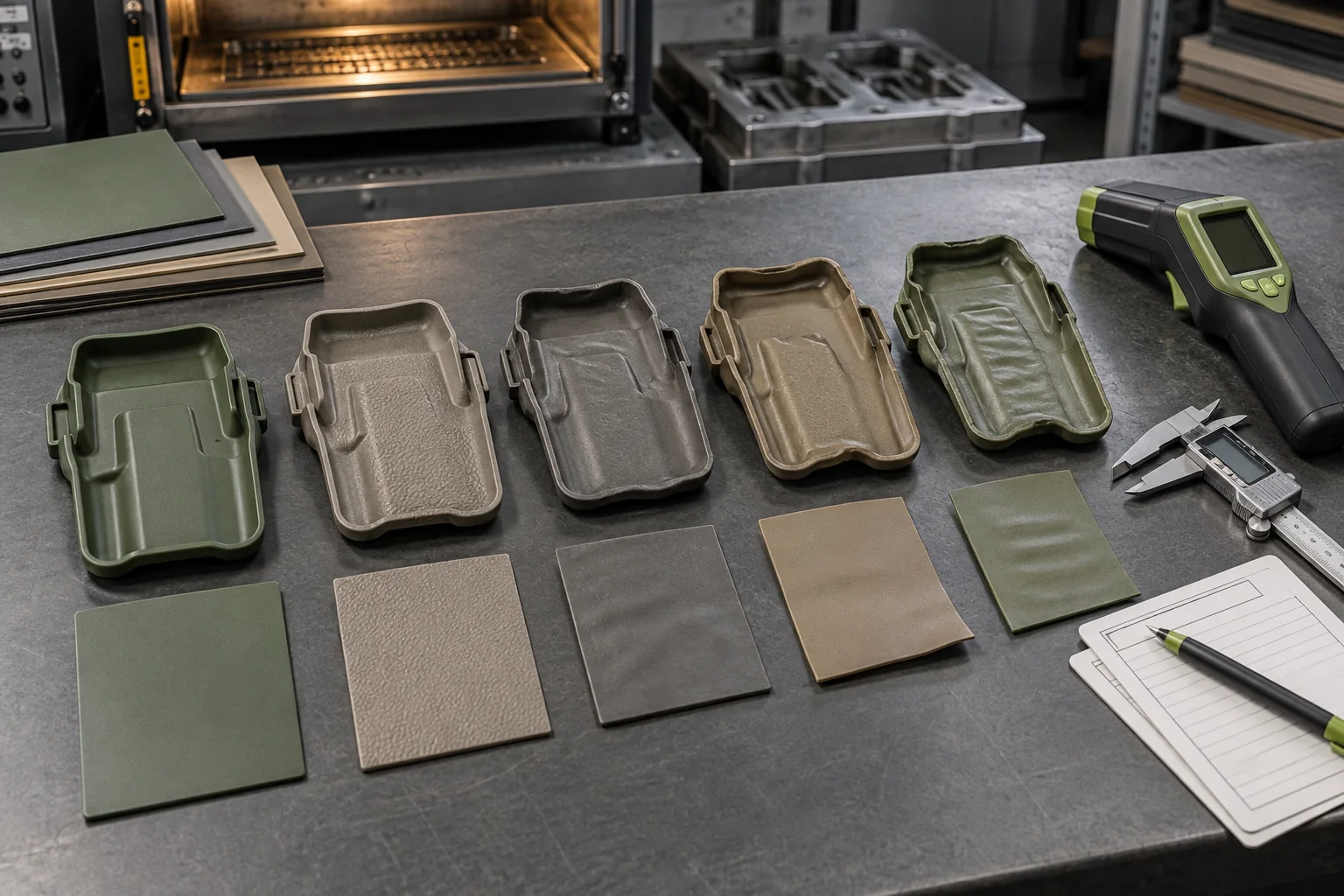
Which thermoforming defects should buyers recognize?
| Observed condition | Possible process area | Buyer evidence to request |
|---|---|---|
| Blisters or bubbles | Heating rate, moisture or temperature balance | Material lot, heating record and affected-area photos |
| Weak formed detail | Sheet temperature, vacuum, tooling or cooling | Critical geometry comparison and process review |
| Uneven wall distribution | Heating uniformity, sag, draw or forming method | Section/thickness checks at agreed locations |
| Corner thinning or tearing | Radius, temperature, draw and vacuum rate | Location map, tool review and revised sample |
| Distortion after forming | Cooling, release timing, trimming or residual stress | Dimensional checks after conditioning |
What does the material manufacturer say?
SEKISUI KYDEX states that heating too quickly is a frequent thermoforming problem and lists causes and remedies for bubbles, poor detail, wall-thickness variation, shrink marks, sticking and tearing in its thermoforming troubleshooting brief. Its ideal forming conditions emphasize controlled surface and core temperature for part quality and consistency.
Those publications explain general material-processing behavior. They do not establish acceptance for a finished holster, carrier or sheath; the product drawing, approved sample and application-specific checks remain the release basis.
How should a nonconformance be documented?
- Identify the SKU, revision, material lot and production lot.
- Photograph the complete part and the affected area with scale.
- Record location, size, frequency and whether the condition is cosmetic, dimensional or functional.
- Compare the result with the released limit or approved sample.
- Contain affected product while the cause and corrective action are reviewed.
- Reapprove the relevant evidence before normal production resumes.
Which checks belong on the finished assembly?
Forming appearance is only one layer. Verify fit reference, seating, removal, required clearances, retention range, edge finish, hole position, fastener engagement, mounting stability and every allowed configuration on the assembled product. Recheck dimensions after an agreed conditioning period when post-form distortion is a concern.
Connect this review to CarryMold’s quality-control framework, manufacturing process guide, sheet sourcing guide and golden-sample process.
Frequently asked questions
Does every surface variation make a part unusable?
No. Acceptance depends on the written cosmetic, dimensional and functional requirements and on where the condition occurs.
Can a defect be diagnosed from one photograph?
Usually not with confidence. Similar symptoms can have different causes, so material, tooling, heating, forming, cooling and trimming evidence may be needed.
Should corrected parts receive a new first-article review?
Use a new review when the correction changes a released process, tool, material or critical product characteristic.
Define the evidence required for a repeatable formed part.
Share the application, target quantity and launch requirements. We will outline the most practical sampling path.