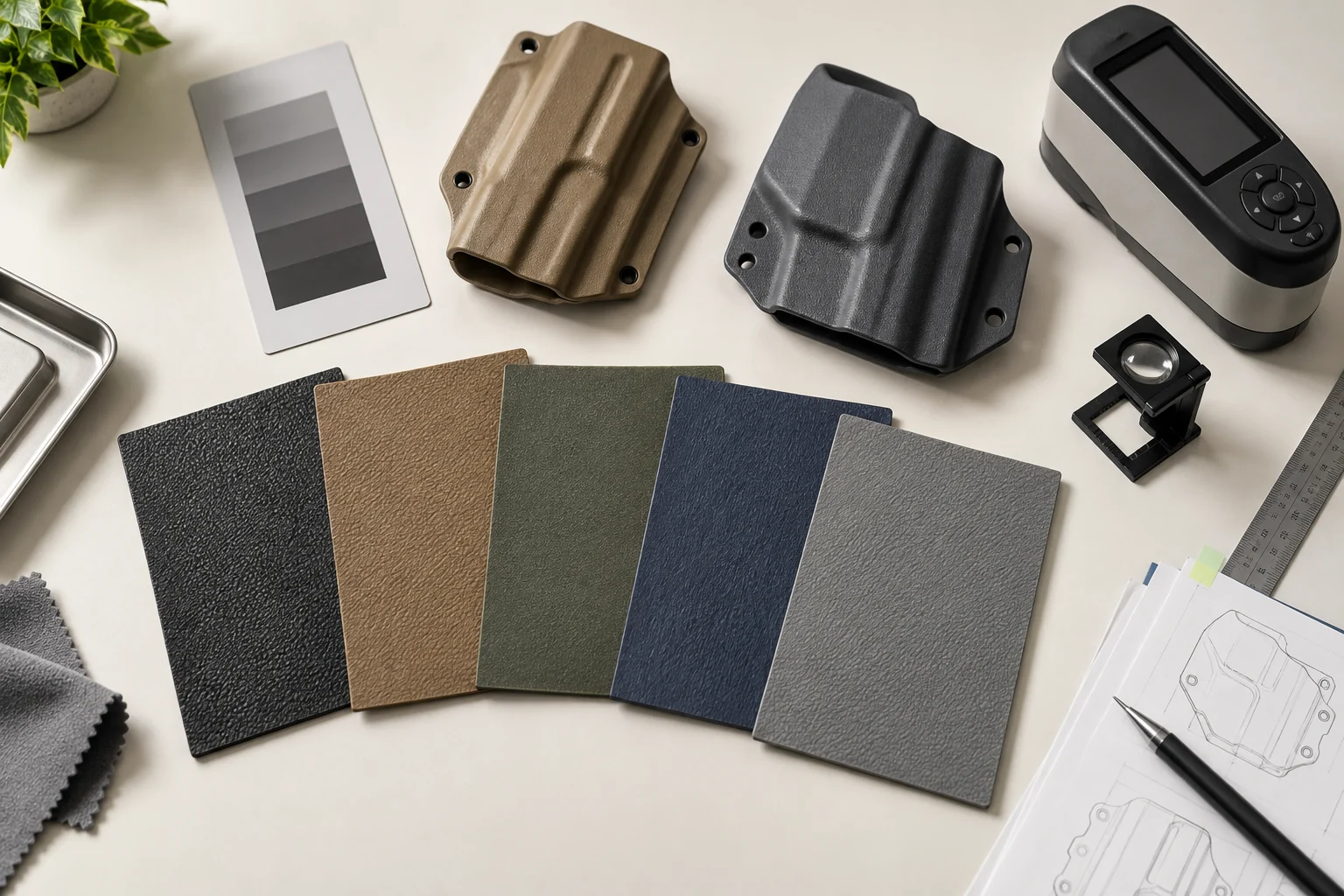
Why can a formed part look different from the flat sheet?
Thermoforming changes the geometry and surface presentation of a sheet. SEKISUI KYDEX explains in its decorative texture guidance that sheet texture stretches as the material is drawn over a tool, with greater distortion possible at deeper draws. The manufacturer also notes in its integral effects and CIE L*a*b technical brief that forming can change apparent thickness, texture and gloss, and that special-effect materials can appear different when sheet direction changes.
For an OEM buyer, this means a supplier sample card is useful for narrowing choices, but the release decision belongs on the finished geometry under agreed viewing conditions.
What belongs in a color and texture specification?
| Control | What to record | Why it matters |
|---|---|---|
| Material identity | Manufacturer, exact grade and approved supplier | Color alone does not prove grade or source |
| Color reference | Manufacturer color code or approved physical master | Names such as black, tan or olive are ambiguous |
| Texture | Sheet texture, side presented and any tool-imparted finish | Surface pattern changes appearance and handling |
| Gloss | Target or approved visual range on the formed part | Heating, draw and texture affect reflected light |
| Orientation | Machine direction or marked blank direction when appearance is directional | Special effects may show visible flop between rotations |
| Viewing method | Light source, angle, distance, background and comparison sample | Uncontrolled inspection creates inconsistent decisions |
| Lot and change control | Traceability, approval basis and reapproval triggers | Repeat orders need the same released standard |
Sheet texture versus in-mold texture
SEKISUI KYDEX distinguishes texture embossed during sheet production from texture created against a textured forming tool. Sheet texture can be used with standard thermoforming equipment but stretches with the draw. In-mold texture can preserve the tool pattern more directly, while requiring the appropriate pressure-forming process and tooling strategy. The correct choice depends on geometry, investment, appearance target and production method; neither route should be described as universally better.
How should an OEM buyer approve appearance?
- Define the use: identify the product family, environment, brand palette and surfaces visible to the customer.
- Shortlist controlled materials: compare manufacturer grade, color code, texture, thickness and availability.
- Form representative geometry: use the intended draw, tool surface, heating method and trim process.
- Compare assemblies: review shell, hardware, webbing, printed marks and packaging together.
- Record the decision: label the approved sample with part number, revision, material and date.
- Define reapproval: require review for changes to grade, source, color, texture, thickness, tool, process or visible component.
Should color be controlled only by a number?
No single number replaces the agreed visual standard. Instrumental color data such as CIE L*a*b can make comparisons more repeatable, but texture, gloss, translucency, direction and formed geometry influence what a person sees. Define the measurement surface and method, then connect numerical limits to an approved formed master and practical visual inspection.
How should a multi-product brand family be managed?
A holster, magazine carrier and mounting accessory may use different thicknesses, forming depths or component materials. They can share a coordinated palette without looking perfectly identical. Decide which elements must match, which may be visually coordinated, and which require a separate approval standard. The released bill of materials should identify every color-bearing component rather than applying one informal color name to the whole family.
Buyer approval checklist
- Exact sheet manufacturer, grade, thickness, color code and texture
- Primary visible side and blank orientation where relevant
- Representative formed sample and assembly configuration
- Approved lighting and viewing method for cosmetic inspection
- Acceptable variation by cosmetic zone
- Hardware, webbing, printing and packaging color relationships
- Master-sample identification, storage and replacement rule
- Lot traceability and documented reapproval triggers
Build the specification with CarryMold’s materials, colors and textures page, sheet sourcing guide, golden-sample approval guide, quality-control framework and OEM manufacturing workflow. Product-family planning can begin in the custom product catalog.
Frequently asked questions
Can a website image be used as the color standard?
No. Screens, cameras, editing and ambient light can change appearance. Use an identified physical material or formed-part reference for approval.
Does the same color code guarantee identical appearance on every geometry?
Not necessarily. Thickness, draw, texture, gloss, orientation and adjacent components can change perceived appearance. Review each materially different formed configuration.
When should color or texture be reapproved?
Reapprove when a change to material grade, supplier, color formulation, texture, thickness, blank direction, tool surface or forming process could alter the released appearance.
Approve the formed appearance before repeat production.
Share the application, target quantity and launch requirements. We will outline the most practical sampling path.