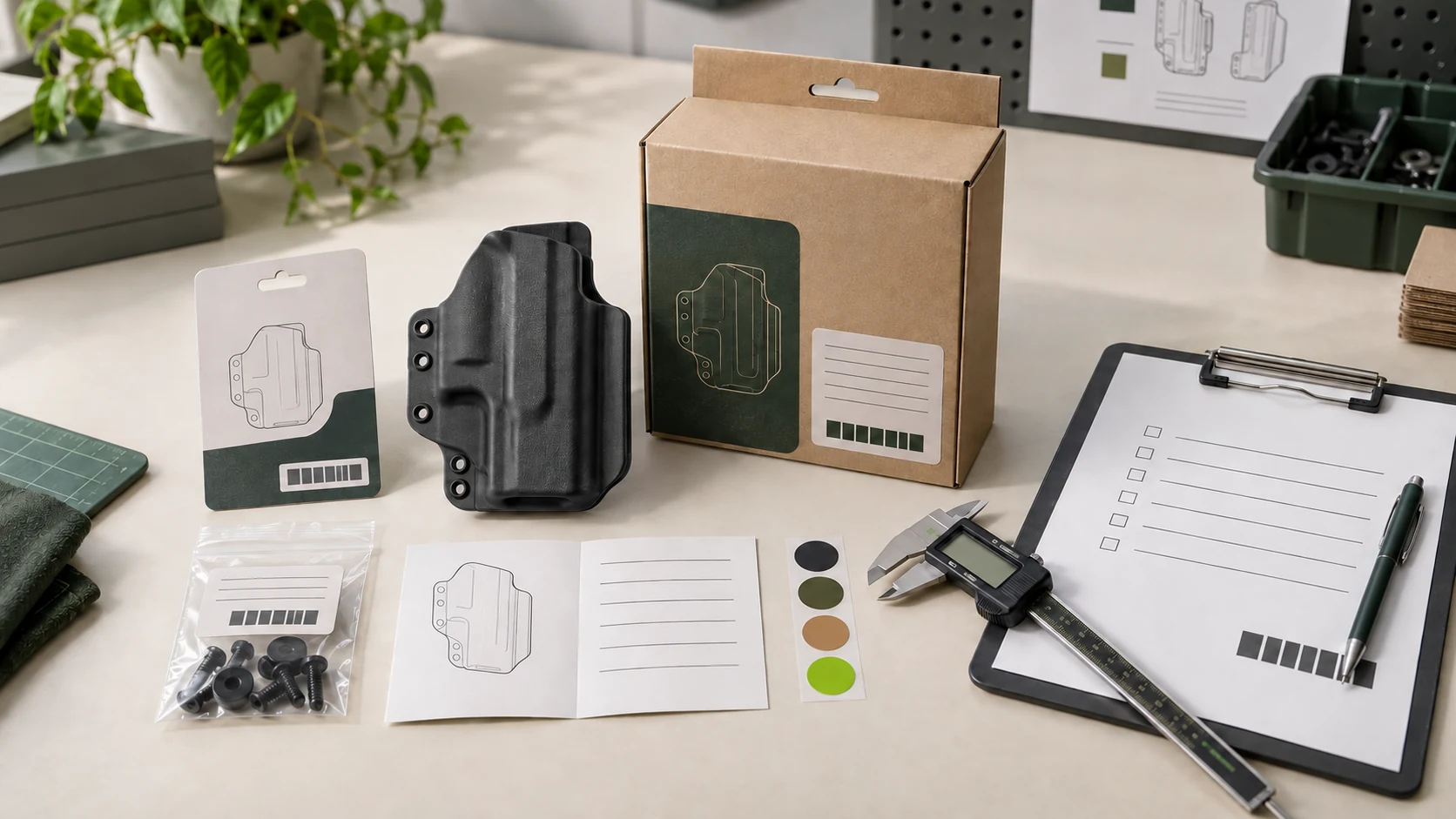
Why should packaging be approved with the product?
A correctly formed product can still become unsellable when the label names the wrong fit, a left/right variant is mixed, mounting hardware is missing, or the carton carries obsolete artwork. Treat the packed unit as a controlled configuration. The physical product, package contents, printed data and digital destinations should all point to the same released SKU.
What belongs in the packaging specification?
| Pack element | Buyer input | Approval check |
|---|---|---|
| SKU identity | Brand SKU, product name, fit reference, side, color and mount | Matches product and purchase order |
| Included contents | Shell, clips, screws, posts, spacers, tools and spare parts | Count and configuration verified |
| Artwork | Versioned print file, colors, finishes and placement | Digital proof plus physical pack sample |
| Barcode data | Buyer-authorized GTIN/UPC/EAN data and assigned SKU relationship | Correct symbol data and scan verification |
| Instructions | Installation, adjustment, care, warnings and language scope | Matches included hardware and approved configuration |
| Unit protection | Bag, insert, wrap, carton and surface-protection method | Product arrives clean and undamaged |
| Case pack | Units per inner/master carton, assortment rule and carton marks | Quantity, variant separation and label placement confirmed |
Who should provide barcode numbers?
The brand owner or an authorized data source should provide the identification data; the supplier should not invent a UPC, EAN or GTIN. The GS1 GTIN Management Standard explains that trade-item identification must distinguish new products and relevant product changes. GS1 also treats packaging levels as part of a hierarchy: an individual sellable unit, case or other level may need separate identification when it is ordered, priced or traded independently. Confirm the applicable GS1 and sales-channel rules for the target market.
How should holster variants be separated?
Do not rely only on a small color difference or an operator recognizing the shell. Build an explicit variant key covering fit reference, handedness, carry orientation, color, material, mounting option and included kit. Use that same key in the purchase order, packing instruction, production traveler, unit label and carton label. If mixed cartons are allowed, define the assortment and how each variant is isolated and counted.
Artwork approval is not pack-out approval
Artwork proof
Checks copy, placement, color intent, dieline, bleed and revision identity.
Physical pack sample
Checks fit, visibility, scuff protection, closure and real print appearance.
Pack-out sample
Checks every included component, instruction and variant label together.
Transit check
Checks the agreed shipping configuration for movement, compression and damage.
Private-label packaging approval workflow
- Freeze the product configuration and assign the buyer SKU.
- List every included component and approved substitute rule.
- Define the unit, inner and master-carton hierarchy.
- Supply controlled artwork and authorized barcode data.
- Review a digital proof for content and layout.
- Approve a physical packed sample with the actual product and hardware.
- Record carton quantity, marks, dimensions and packing sequence.
- Lock the approved file versions and define reapproval triggers.
What should trigger reapproval?
Reapprove when a product fit, handedness, mount, color, included component, instruction, language, brand artwork, barcode, pack quantity or carton construction changes. GS1 maintains specific rules for when a trade-item change requires a new GTIN; the brand owner should make that decision using the current standard and channel requirements rather than reusing an identifier by assumption.
Buyer release checklist
- Product part number and revision match the package
- SKU name clearly distinguishes fit, side, color and mounting option
- All hardware and instructions are present and correct
- Buyer-authorized barcode data is linked to the correct item
- Artwork files, dielines and proofs carry revision identifiers
- Physical pack sample protects finished surfaces and edges
- Inner and master-carton quantities and marks are defined
- Mixed-SKU and split-delivery rules are written where applicable
- Destination-market labeling and warnings receive qualified review
- Golden pack sample and reapproval triggers are retained
Coordinate packaging with CarryMold’s private-label program overview, golden-sample approval guide, first-article inspection checklist, hardware options, quality framework and OEM manufacturing workflow.
Frequently asked questions
Can the supplier create a barcode for my brand?
The buyer should provide identifiers obtained through an authorized source and confirm ownership and assignment. A supplier can place approved data into artwork and verify the printed symbol, but should not invent ownership.
Can one package be used for left- and right-hand variants?
It can use shared structural packaging only when the variant is unmistakably identified and the packing process prevents mixing. The sellable SKU and label data must remain configuration-specific.
Is a PDF artwork approval enough?
No. A digital proof checks content and layout, but a physical pack-out sample is needed to review print appearance, fit, included contents, protection and label placement.
Approve the complete sellable SKU before repeat production.
Share the application, target quantity and launch requirements. We will outline the most practical sampling path.