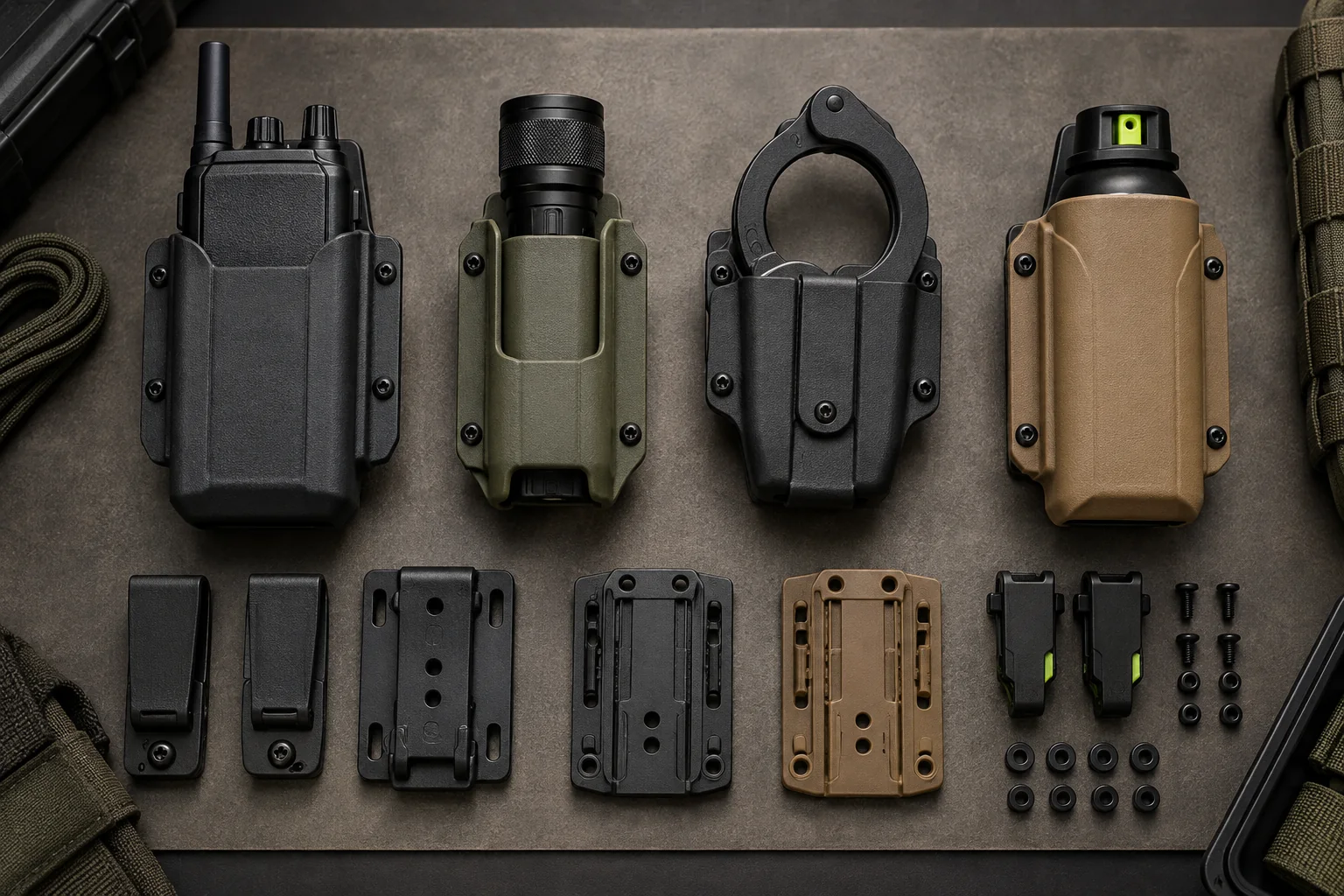
Which equipment carriers can share one program?
Brands often coordinate radio, flashlight, restraint, spray and medical carriers as a product family. They can share material, color, edge language, hardware and packaging, but every carrier still needs its own controlled fit reference and functional checks.
| Carrier family | Critical inputs | Sample checks |
|---|---|---|
| Radio | Device, battery, knobs, ports and antenna path | Control access, cable routing and removal |
| Flashlight | Body diameters, head, tailcap and clip | Insertion range, rattle and switch access |
| Restraint | Approved model and orientation | Retention, access and mounting clearance |
| Spray canister | Diameter, height, actuator and cap | Coverage and unobstructed deployment path |
| Medical item | Packaged dimensions and removal direction | Access with intended gloves and platform |
Define access before styling
Mark keep-clear zones for displays, switches, connectors, battery releases and grip surfaces. Then define the required coverage and retention points around them. This prevents a visually clean shell from obstructing the function that matters most.
Choose the mounting system as part of the carrier
Belt clips, closed loops, MOLLE adapters and quick-change plates produce different loads and clearances. Specify belt width or the representative host panel, permitted orientation, occupied space, fastener stack and whether field removal requires tools.
Review radio carrier development, MOLLE components, belt attachments and the radio and flashlight platform.
What belongs in the RFQ?
- Exact item and production configuration
- Physical sample, controlled dimensions or approved 3D data
- Required access and viewing zones
- Retention and adjustment expectation
- Belt, MOLLE, hook-and-loop or fixed mounting interface
- Color, marking, included hardware, packaging and quantities
Frequently asked questions
Can one carrier fit several device models?
Only when the allowed dimensional range and functional behavior are designed and validated into the specification.
Can several carriers use the same hole pattern?
Yes, when edge distance, load path and hardware clearance remain acceptable for every approved geometry.
Should the carrier be tested while mounted?
Yes. Bench fit alone does not show movement, access or fastener behavior on the intended belt or equipment platform.
Specify communications carriers by device configuration
For radios and related communications equipment, the radio holster development guide shows how to control battery envelopes, access zones, cable routing, retention and mounting.
Define the carrier and MOLLE interface together
The MOLLE mounting guide turns host-platform dimensions, occupied rows and columns, orientation and removal requirements into an approvable carrier system.
Define the equipment, access zones and host platform.
Share the application, target quantity and launch requirements. We will outline the most practical sampling path.