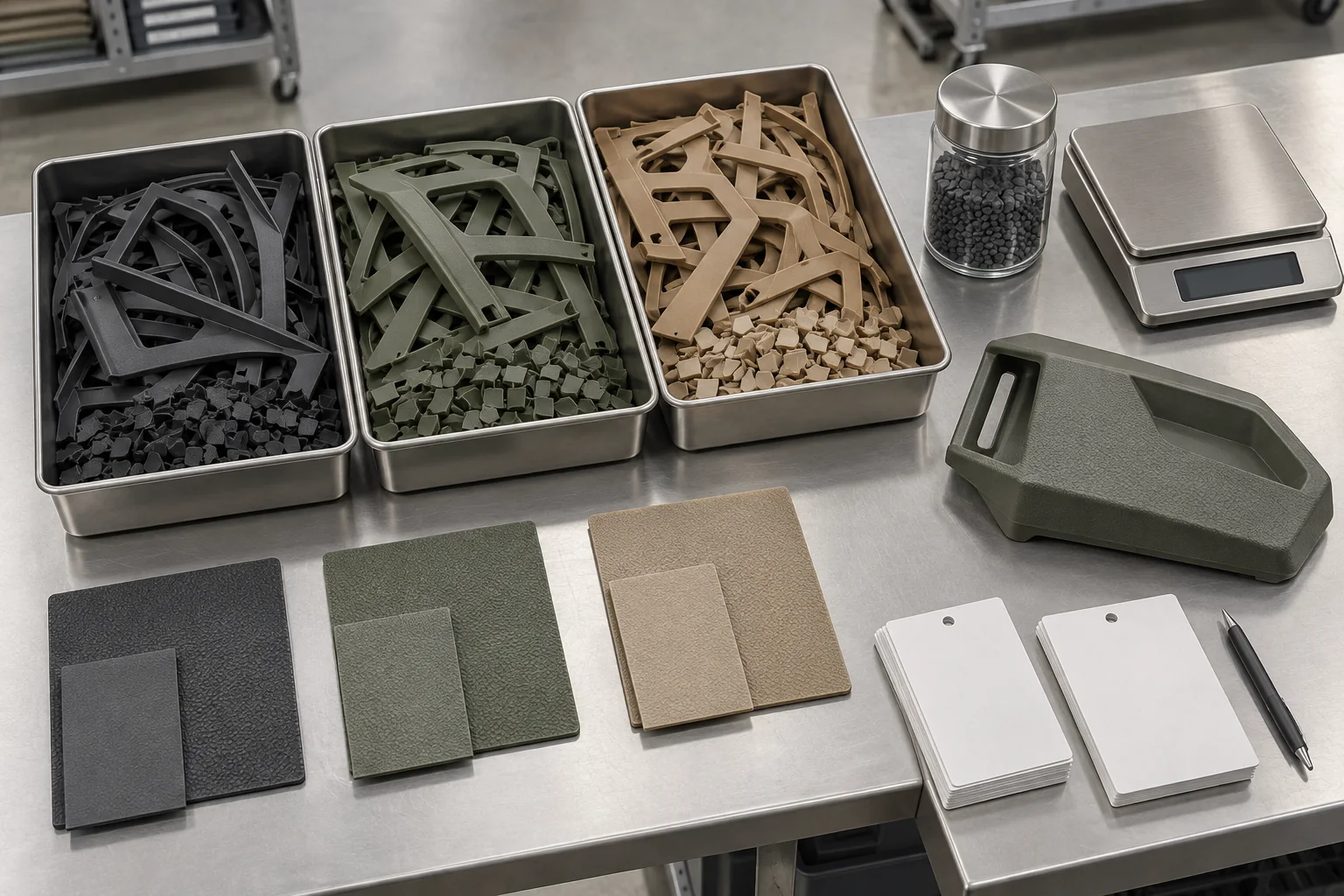
Which environmental questions are commonly confused?
Four different questions often collapse into one marketing phrase. Is the polymer technically capable of being reprocessed? Is there an operational collection and recycling route for this material at the production location? Does the purchased sheet contain a verified proportion of recycled material? Can the brand make a product-level claim under the rules of its sales market? Evidence for one question does not automatically answer the others.
Environmental-claim decision map
| Statement | What it means | Evidence to request |
|---|---|---|
| Recyclable material | The identified material can technically be reprocessed under suitable conditions | Current supplier guidance and individual product/recycling-code information |
| Scrap is collected | A named production scrap stream is segregated and leaves the facility through a defined route | Material scope, segregation rule, receiver, period and disposition record |
| Contains recycled content | The supplied material or component has a defined recycled-content claim | Supplier declaration, basis, percentage, boundary, lot/order link and applicable standard |
| Closed-loop program | Recovered material returns into a defined equivalent product or system | Chain of custody, processor, material balance and qualification evidence |
| Lower environmental impact | A comparison is being made against a stated baseline | Defined boundary, method, data period and substantiated comparison |
What does SEKISUI KYDEX state?
The official product FAQ says KYDEX and ALLEN sheet grades can be recycled and advises contacting the supplier for the recycling code of an individual product. It also describes internal re-extrusion of out-of-specification product. The Environmental Aspects TB 110A discusses the thermoplastic basis for reprocessing KYDEX sheet. These supplier statements support material-level recyclability, but they do not by themselves establish recycled content or an available local recovery route for a particular CarryMold order.
Why does local recycling infrastructure matter?
A technically recyclable material may need identification, minimum volume, cleanliness, sorting, transport and a processor willing to accept that exact stream. SEKISUI KYDEX’s report on its thermoplastic trim-scrap partnership describes identification, storage, handling, cleaning, inspection, sorting and repurposing as necessary systems beyond simply grinding scrap. Buyers should verify the route applicable to the actual manufacturing location and period.
What should be separated at the factory?
| Scrap category | Control question |
|---|---|
| Clean sheet offcut | Is grade, color, texture, gauge and lot identity retained? |
| Formed trim skeleton | Has it contacted adhesives, coatings, labels or mixed hardware? |
| Process setup/reject | Is the material known and free from foreign components? |
| Assembled-product reject | Can incompatible hardware, foam, textile or adhesive be separated? |
| Mixed or unidentified scrap | Does the intended receiver permit it, or must it use another disposition? |
Is factory regrind the same as recycled content in the customer’s part?
No. Internal recovery of process material and a product claim about recycled content have different boundaries. Do not assume that collected trim returns to the same grade, color or customer product. If recycled content is requested, define whether it is pre-consumer or post-consumer, the claimed proportion, calculation basis, product boundary, traceability evidence and whether it changes appearance or performance approval.
How should an OEM protect product requirements?
Environmental goals do not replace material and functional requirements. Specify the approved grade, gauge, color, texture, formed-wall needs, cosmetic zones and applicable compliance before deciding whether an alternative or recycled-content material is acceptable. Use the incoming-material guide for identity and segregation, the color/texture guide for physical appearance, and the first-article process when a material change can affect the released product.
What wording should a private-label brand avoid?
Avoid absolute or vague statements such as “eco-friendly,” “zero waste,” “100% recyclable everywhere” or “closed loop” unless the scope, evidence and market rules support them. Do not turn a supplier’s corporate program into a claim about the converter or the finished SKU. The private-label program should keep approved environmental copy tied to its owner, evidence revision, region and exact product.
What should a buyer ask during quotation?
State the requested material, order volume, markets, mandatory claims, recycled-content target if any, packaging boundary and documentation expectations in the RFQ. Ask what production scrap types are generated, how they are identified, whether a current receiver accepts them and what evidence can actually be supplied. CarryMold should confirm program-specific feasibility rather than copy a generic sustainability promise into the quotation.
Frequently asked questions
Is every KYDEX product recyclable in my city?
Supplier guidance says the sheet grades can be recycled, but acceptance depends on the individual product and available local collection and processing infrastructure.
Does recyclable mean biodegradable?
No. Recyclability and biodegradability are different material claims and require different evidence.
Can trim scrap be mixed across colors and grades?
Only if the identified receiving process accepts that mixture. Segregation requirements should be agreed before the scrap stream is described as recyclable.
Does this page certify CarryMold recycled content?
No. This is a buyer framework. Any recycled-content or recovery claim must be confirmed for the quoted material, facility, order and supporting evidence.
Turn the sustainability question into a verifiable material brief.
Share the application, target quantity and launch requirements. We will outline the most practical sampling path.