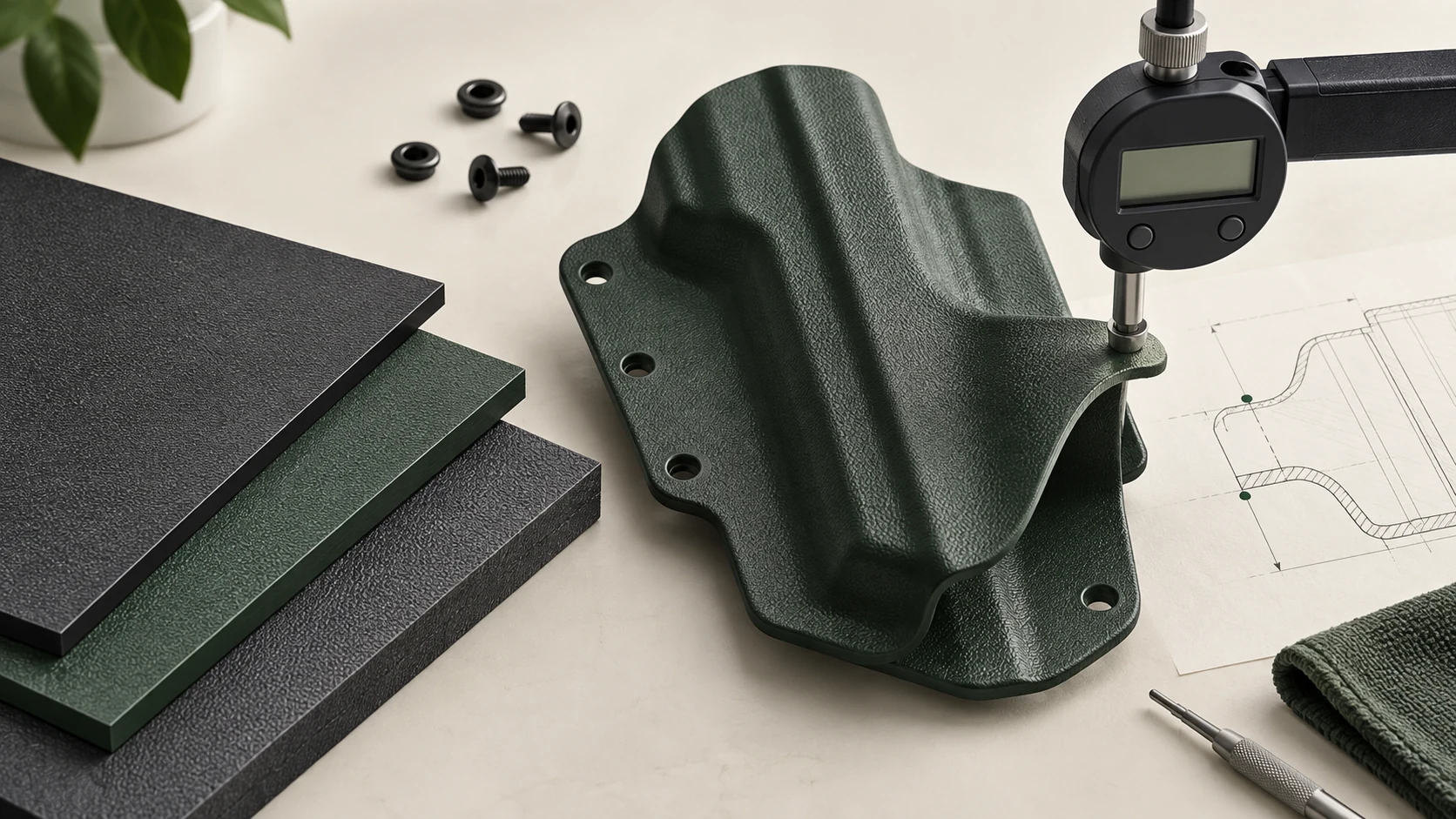
Why does the wall become thinner during forming?
When a flat thermoplastic sheet is formed into a three-dimensional part, its surface area increases and material is distributed across the geometry. SEKISUI KYDEX explains in Technical Brief 140F that draw ratio and area ratio help estimate this thinning, while the actual distribution depends on the part and forming method. Its thermoforming fundamentals also describes how male and female molds place thicker and thinner regions differently.
What should an OEM buyer specify?
| Control | Record in the specification | Release evidence |
|---|---|---|
| Material identity | Manufacturer, exact grade, approved source and lot traceability | Material record and approved bill of materials |
| Starting gauge | Nominal thickness and applicable tolerance | Incoming-sheet measurement |
| Formed geometry | Drawing revision, mold side and critical depth or draw features | Approved formed sample |
| Critical wall areas | Named measurement locations and minimum acceptance values where needed | Documented thickness readings |
| Functional result | Retention, flex, mounting and clearance checks | First-article and lot-release results |
| Change control | Reapproval triggers for gauge, grade, source, tool or process changes | Revision history and new approval |
Is thicker sheet always better?
No. A thicker starting sheet may increase stiffness or provide more material for a demanding draw, but it can also affect forming detail, edge bulk, hardware stack, weight and assembly clearance. A thinner sheet may form fine detail more readily but can leave insufficient material in highly stretched or loaded zones. Select the gauge around the complete design and verify the finished part; do not substitute a universal thickness rule for engineering approval.
How do mold type and geometry affect distribution?
In simple terms, the first-contact region tends to retain more of its starting thickness while material traveling farther across the tool can thin more. Deep pockets, sharp transitions and large surface-area increases deserve particular attention. Female and male molds do not distribute material identically, and pre-stretch or plug-assist methods can change the result. The purchase drawing should therefore identify critical areas on the actual part rather than request random measurements.
Starting gauge versus formed-wall control
Starting sheet gauge
Useful for purchasing, incoming inspection, heating strategy and baseline material control.
Minimum formed wall
Useful at critical retention, mounting, bend or impact areas where local thinning matters.
Approved sample
Connects measurements to real fit, retention, edge quality, appearance and assembly behavior.
Functional test
Confirms the complete product performs under the agreed configuration and test condition.
How should thickness be measured?
Use a suitable calibrated instrument and a documented method. Name the measurement locations, avoid inconsistent pressure on flexible edges, and record whether coatings, laminates or stacked shells are included. Where a location cannot be reached reliably, agree on a representative coupon, destructive-section method or process-control alternative. The method must be repeatable enough for two inspectors to reach the same release decision.
Buyer approval workflow
- Define the product use, fit reference, mounting loads and critical clearances.
- Select a controlled material grade and candidate starting gauge.
- Form representative geometry with the intended tool and process.
- Map likely thin zones and measure agreed critical locations.
- Test retention, access, mounting, flex and edge condition on the complete assembly.
- Approve a golden sample and lock material, gauge, tool and process revision.
- Define routine inspection frequency and reapproval triggers for repeat orders.
Use this guide with CarryMold’s materials, colors and textures options, KYDEX sheet sourcing guide, thermoforming defect inspection guide, first-article checklist, quality-control framework and OEM development workflow.
Frequently asked questions
Does a 0.080-inch starting sheet remain 0.080 inch everywhere?
No. Forming redistributes the sheet and local wall thickness varies with geometry, draw and process conditions. Measure critical formed locations when the application requires a minimum.
Can nominal gauge alone predict retention?
No. Retention also depends on geometry, contact zones, forming accuracy, hardware, adjustment and the approved fit reference. Validate the finished assembly.
When should thickness be reapproved?
Reapprove when changes to material grade, source, nominal gauge, tool geometry, mold type or forming process could alter wall distribution or product function.
Start with the nominal holster gauge
For common carry-product starting gauges, review the 0.060, 0.080 and 0.093 inch KYDEX holster thickness comparison. Then use this formed-wall guide to specify where thinning is measured and accepted after forming.
Separate wall-thickness control from finished-part dimensions
This guide controls starting gauge and formed-wall measurement. Use the thermoformed-part drawing and tolerance guide for datums, trim features, dimensional measurement state and first-article reporting.
Specify the finished part—not only the flat sheet.
Share the application, target quantity and launch requirements. We will outline the most practical sampling path.