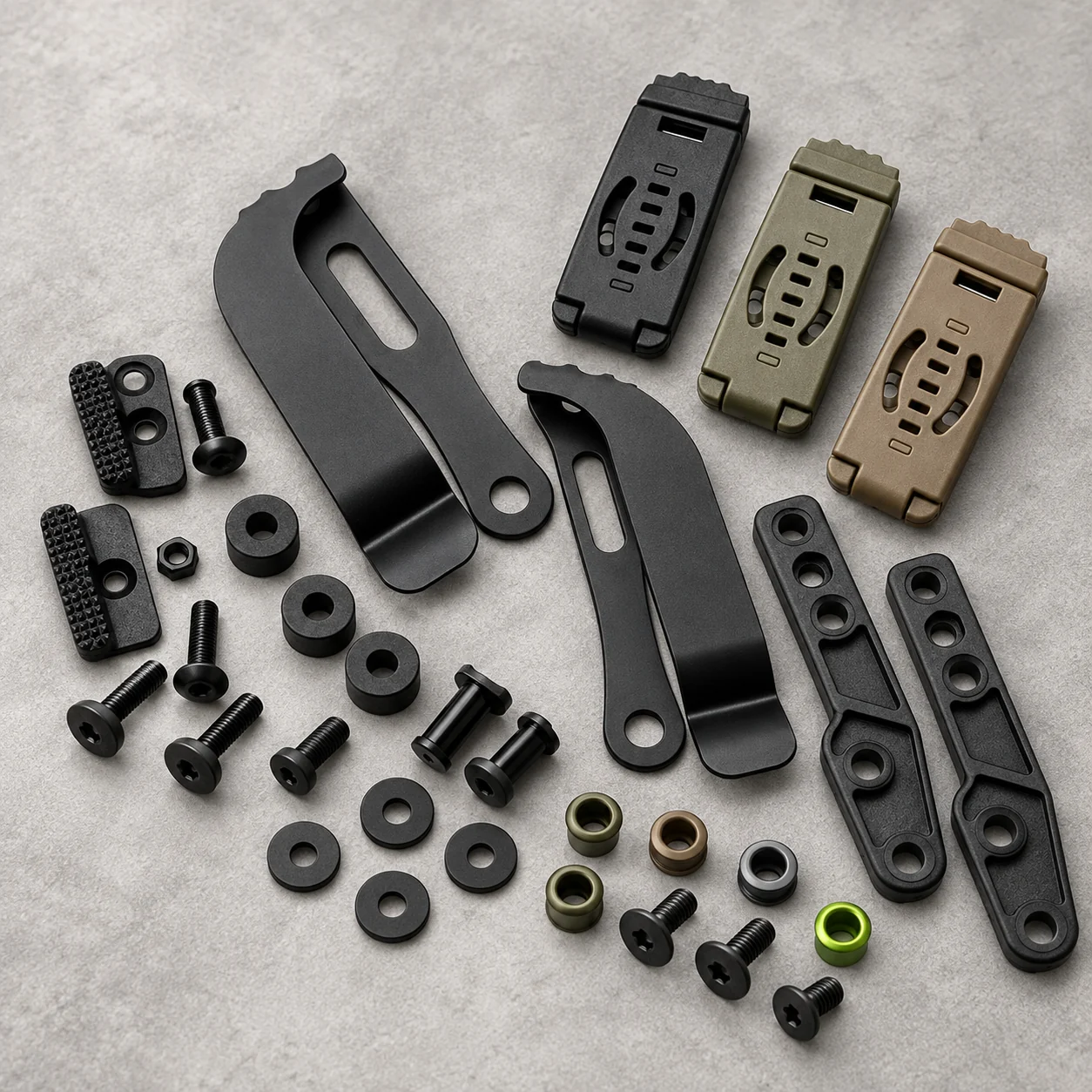
Hardware families for OEM holster programs
Fasteners
Screws, posts, washers, spacers and thread-control methods are documented as an assembly stack.
Retention components
Spacer hardness, compression range and adjustment access are reviewed on the finished product.
Concealment features
Wing and claw concepts are evaluated with the intended belt, carry position and shell clearance.
What an approved hardware specification controls
| Component | Control point | Approval check |
|---|---|---|
| Screw and post | Diameter, length, head, finish | Engagement and internal clearance |
| Spacer | Material, hardness, free length | Adjustment range and recovery |
| Eyelet | Size, finish, forming method | Flare quality and shell integrity |
| Clip or wing | Hole pattern, geometry, resin | Installation, movement and load |
Replacement and private-label kits
Programs can define factory-installed hardware and separately packed service kits. Pack-out should identify compatible SKU, quantity and installation guidance without implying universal compatibility.
Compare clip and belt-attachment decisions or review our private-label program.
Frequently asked questions
Can one screw length fit every assembly?
No. Stack thickness and required engagement must be verified for each approved configuration.
Can hardware colors be coordinated?
Selected finishes may be coordinated, subject to availability and lot-to-lot color tolerance.
Can CarryMold pack spare hardware kits?
Yes. Kit contents, labeling and compatibility statements are defined in the packaging specification.
Approve hardware as a complete stack
Screw thread alone does not define a working joint. Review the OEM fastener-stack guide for posts, washers, spacers, engagement, bottoming, adjustment and replacement-kit controls.
Choose the joining architecture before releasing hardware
The KYDEX bonding-versus-mechanical-fastening guide compares permanent and serviceable joints, mixed substrates, expansion allowance, load distribution and validation evidence.
Specify every component in the assembly stack.
Share the application, target quantity and launch requirements. We will outline the most practical sampling path.