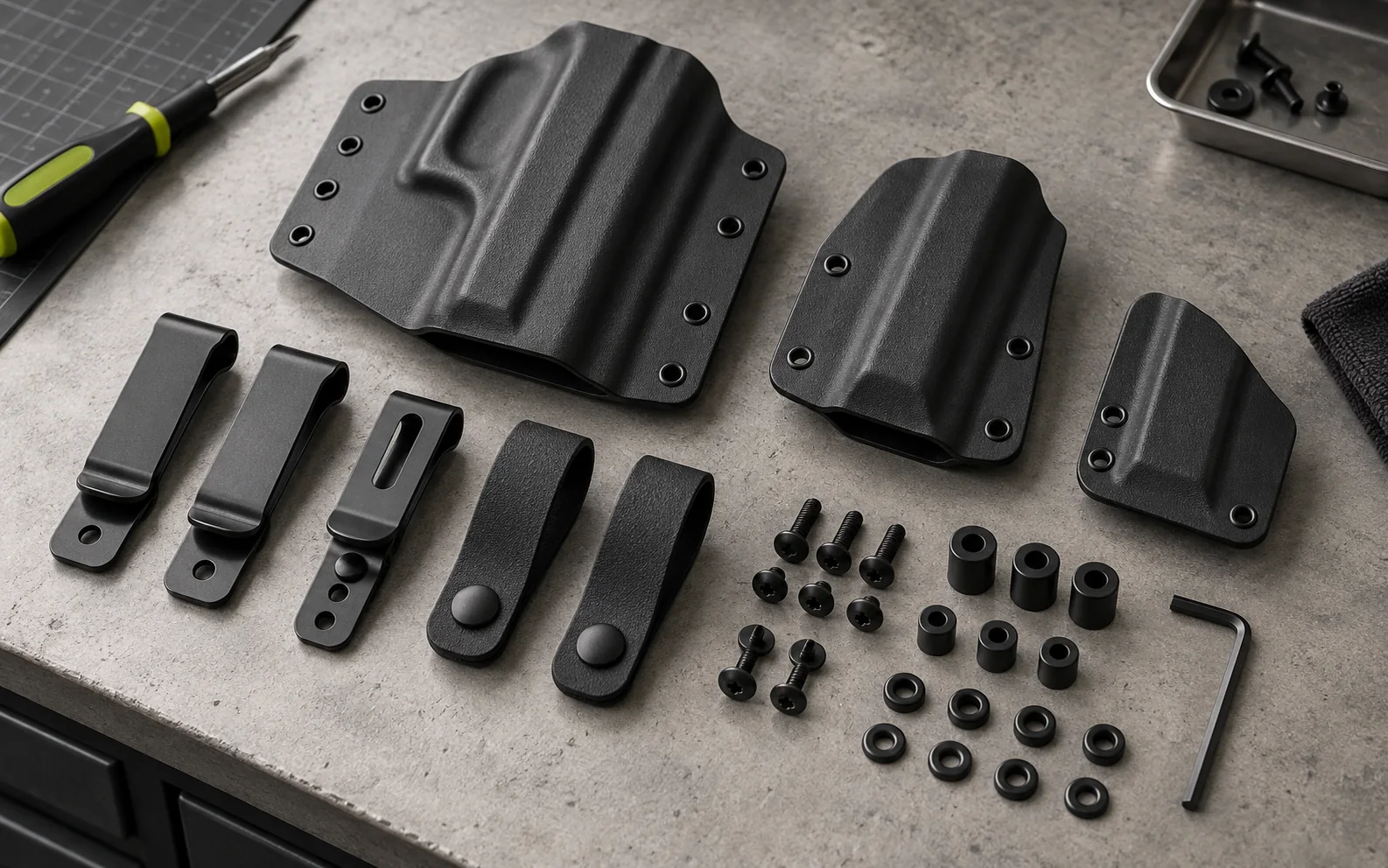
Why the attachment is a system decision
A Kydex shell and its attachment share the load. Moving a hole, changing a spacer or substituting a clip can alter leverage, concealment and stability. For OEM work, hardware should therefore be identified in the approved bill of materials rather than treated as a generic accessory.
Common attachment families
| Format | Typical design focus |
|---|---|
| Over-the-belt clip | Installation, belt capture and profile |
| Soft loop | Wrap geometry, snap orientation and flexibility |
| Closed belt loop | Belt-width tolerance and fixed stability |
| Paddle | Body-side shape, retention tabs and load spread |
| Quick-change interface | Hole pattern, clearance, lock engagement and rotation control |
What to put in the OEM brief
Specify belt width and thickness, intended carry position, ride-height range, cant range, fasteners, spacer stack, torque or thread-locking method, finish and replacement policy. Request a drawing or controlled sample showing every mounting position.
Prototype checks
- Install and remove the product on the intended belt.
- Check movement during representative walking, sitting and draw motions.
- Confirm fasteners do not contact the carried item.
- Inspect the shell around holes after repeated adjustment.
- Verify left- and right-hand configurations independently.
See our IWB Kydex holster and OWB Kydex holster development pages.
Frequently asked questions
Can the same hole pattern support several clips?
Sometimes, but compatibility should be established by drawing and sample verification rather than assumed.
Should replacement hardware be defined?
Yes. A controlled service kit reduces ambiguity for customers and repeat orders.
Can mounting hardware be private labeled?
Marking and packaging options depend on the selected component and order specification.
Specify the shell and hardware together.
Share the application, target quantity and launch requirements. We will outline the most practical sampling path.