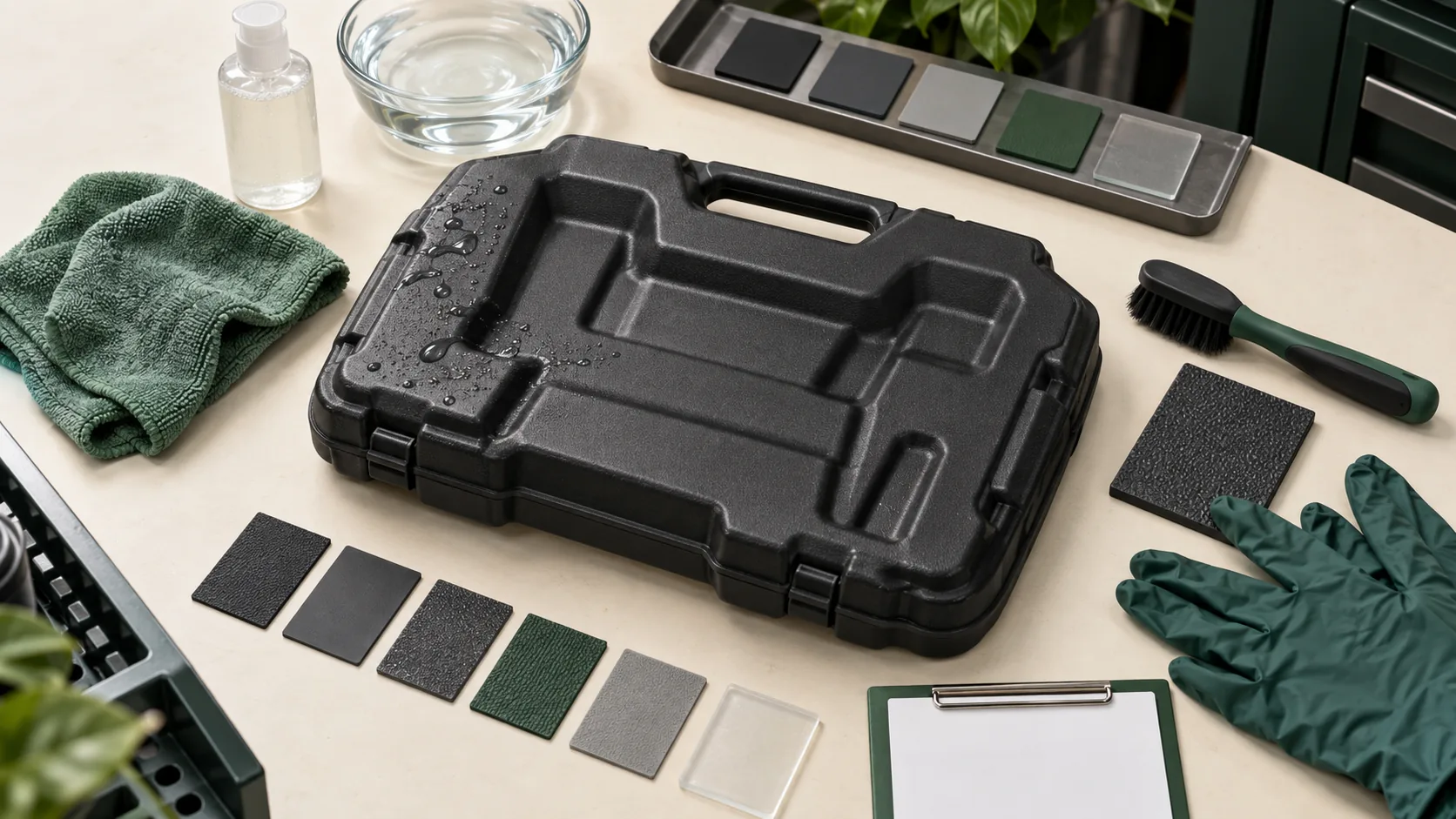
Why should cleaning be part of an OEM product specification?
Cleaning instructions affect appearance, surface texture, labels, printed graphics, adhesives and hardware—not just the formed shell. A brand selling holsters, equipment carriers or mounting products needs instructions that match the released material and complete assembly. Generic claims such as “chemical resistant” do not replace a documented maintenance method or exposure validation.
Cleaning and compatibility decision map
| Use condition | Starting method | OEM evidence |
|---|---|---|
| Dust and light soil | Soft damp cloth; gentle wiping | Approved appearance after repeated cleaning |
| Routine dirt | Mild soap and lukewarm water; rinse and blot dry | Instruction text, material ID and texture reference |
| Soil in texture valleys | Suitable soft or short stiff-bristle brush, then rinse | Texture/gloss comparison and scratch review |
| Oil, stain or adhesive residue | Do not improvise; validate a named product and contact method | Exposure concentration, time, temperature and acceptance result |
| Disinfection or institutional use | Match the disinfectant and protocol to the identified sheet grade | Grade-specific supplier evidence plus assembly-level confirmation |
What does the sheet manufacturer recommend for routine care?
SEKISUI KYDEX’s Cleaning KYDEX Sheet TB 160 recommends a soft damp cloth or chamois for dust, and soap with lukewarm water for light dirt. It advises rinsing and blotting the surface to limit streaks and water spots. For dirt or grease held in texture valleys, the bulletin describes loosening the soil with a short stiff-bristle brush followed by a water rinse.
Why is a chemical-resistance table not a universal cleaning list?
A material coupon result and a finished product instruction answer different questions. The supplier’s Chemical Resistance of KYDEX Thermoplastic Sheet TB 120A reports different outcomes for different substances and conditions. For example, it lists no change for water and isopropyl alcohol in a general table, while acetone, ethyl acetate, toluene and xylene are identified as attacking the material. That evidence should prompt controlled review—not broad permission to expose every CarryMold assembly to any concentration or contact duration.
Compatibility evidence should state the test boundary
| Evidence field | Why it matters |
|---|---|
| Material grade, color and texture | Results should be traceable to the released sheet, not “KYDEX” in general. |
| Chemical identity and concentration | Similar product names can contain different active ingredients or solvents. |
| Contact mode and duration | A wipe-and-rinse event differs from immersion or trapped residue. |
| Temperature and repetitions | Heat and cumulative cycles can change the exposure severity. |
| Acceptance criteria | Record color, gloss, texture, stress cracking, mass or functional change as relevant. |
| Complete assembly scope | Fasteners, elastomers, hook-and-loop, foam, labels and printing may set the practical limit. |
How should brands write a customer care insert?
Use short actions a customer can follow: remove loose soil; use the approved mild solution; avoid excessive heat and named unapproved solvent classes; rinse when required; dry before storage; and contact the brand before using a strong stain remover or disinfectant. Keep consumer wording consistent with the approved bill of materials and region-specific safety obligations. A care insert should not copy a sheet bulletin without checking the assembled SKU.
What should be checked on a first article?
Include a representative cleaning cycle in the first-article inspection plan when care appearance is commercially important. Compare the cleaned unit with the approved sample under defined lighting. Check texture, gloss, printed marks, label adhesion, hardware finish and joint behavior. For private-label programs, release the instruction revision with the packaging and SKU file.
Connect care instructions to material and product use
Start with the identified grade, color and texture in the material program. For outdoor exposure, use the separate weatherability guide; cleaning compatibility does not prove UV, temperature-cycle rain or long-term environmental performance. Record product-specific limits through the quality framework and include them in the RFQ brief when a named chemical or maintenance protocol is required.
Frequently asked questions
Can all KYDEX products be cleaned with isopropyl alcohol?
No universal permission should be inferred. Supplier tables may report a result for sheet under stated conditions, but concentration, grade, finish, print, adhesive and assembled components still need review.
Is a textured surface harder to clean?
Texture valleys can retain soil. The manufacturer describes brush-assisted cleaning for ground-in dirt or grease, but the brush and repetition should be checked against the approved appearance.
Does chemical resistance mean stain resistance?
Not necessarily. Chemical attack, staining, gloss change, texture damage and loss of mechanical performance are different acceptance questions.
Should cleaning instructions be part of packaging approval?
Yes when the brand supplies care guidance. The released copy should match the exact SKU and assembly, and changes should follow the same document-control path as other packaging content.
Turn material guidance into an approved customer-care specification.
Share the application, target quantity and launch requirements. We will outline the most practical sampling path.