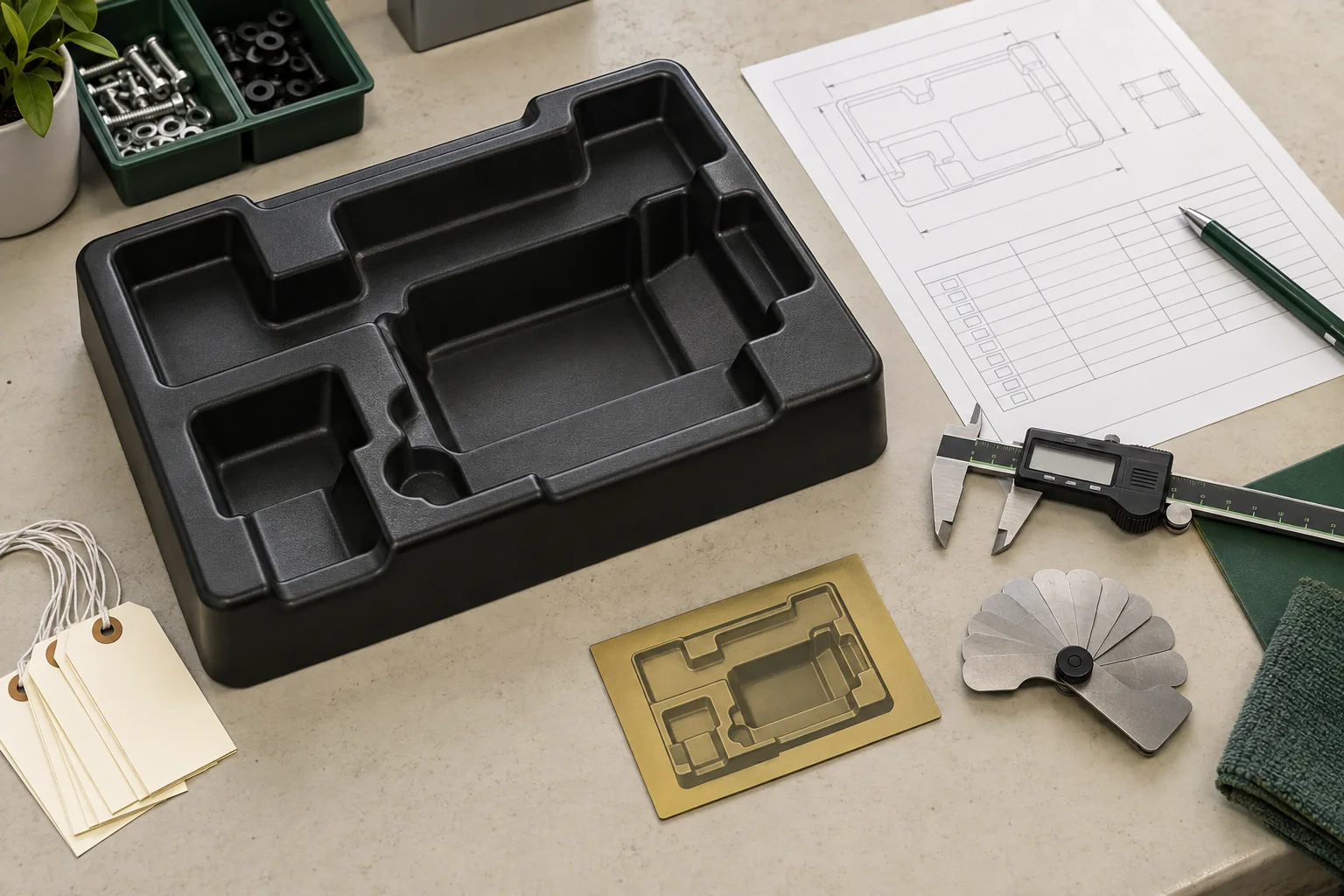
What is the difference between a prototype, first article and golden sample?
| Stage | Main purpose | Release meaning |
|---|---|---|
| Prototype | Explore geometry, fit, access and mounting | Open changes are expected |
| First article | Document conformity of an identified production-representative sample | Approve, reject or conditionally disposition the submitted configuration |
| Golden sample | Provide a controlled physical reference for future interpretation | Supports repeat-production comparison when tied to the same revision |
| Production inspection | Monitor released lots against defined controls | Ongoing acceptance, not a repeat of development |
What should a first article package identify?
- Part number, product name, revision and inspection date
- Fit reference, permitted configuration and representative host equipment
- Sheet manufacturer, exact grade, nominal thickness, color and texture
- Forming tool or approved process reference where relevant
- Hardware bill of materials, quantities, orientation and fastener stack
- Drawing characteristics, method, requirement and actual result
- Cosmetic zones, edge standard, marking and packaging revision
- Every deviation, its disposition, approver and required follow-up
Inspection checklist for a molded carry assembly
| Review area | Example checks | Evidence |
|---|---|---|
| Identity and traceability | Correct revision, material and component configuration | Part record, BOM and labeled sample |
| Formed shell | Detail, wall condition, distortion, openings and trim | Photos and agreed dimensional results |
| Fit and access | Seating, removal, required clearance and control access | Configured fit check and result record |
| Retention | Mechanism action or defined passive/adjustable method | Written test condition and actual result |
| Mounting and hardware | Pattern, engagement, orientation, movement and clearance | Installed assembly review |
| Appearance and edges | Texture, color, marks, burrs and user-contact surfaces | Approved visual standard or reference |
| Pack-out | SKU, labels, instructions, included parts and protection | Packaged sample and checklist |
When should first article inspection be repeated?
Repeat the affected portion when a change can alter a released characteristic: fit reference, sheet grade, forming tool, trim program, hole pattern, retention geometry, mounting component, hardware stack, approved supplier, artwork or packaging. Also define a response when production resumes after a long interruption or when corrective action changes the approved process.
Does this guide claim AS9102 compliance?
No. SAE describes AS9102 as an aerospace first-article documentation requirement. This CarryMold checklist is a general B2B planning framework for custom molded carry products; it is not an AS9102 form, certification or statement of aerospace compliance. If a contract names a regulated or customer-specific standard, that requirement controls the inspection package.
Connect the report to CarryMold’s quality-control framework, golden-sample approval guide, thermoforming defect guide, OEM workflow and hardware specification page.
Frequently asked questions
Is the first molded sample automatically a first article?
No. A useful first article is identified, production-representative and reviewed against released requirements with recorded results.
Does passing first article inspection guarantee every production unit?
No. It establishes evidence for the submitted configuration. Repeat production still needs appropriate incoming, in-process, final and change controls.
Can photographs replace dimensional and functional results?
No. Photographs support identity and visual evidence, but they cannot establish every dimension, fit, force, clearance or installed behavior.
Define the evidence required before production release.
Share the application, target quantity and launch requirements. We will outline the most practical sampling path.