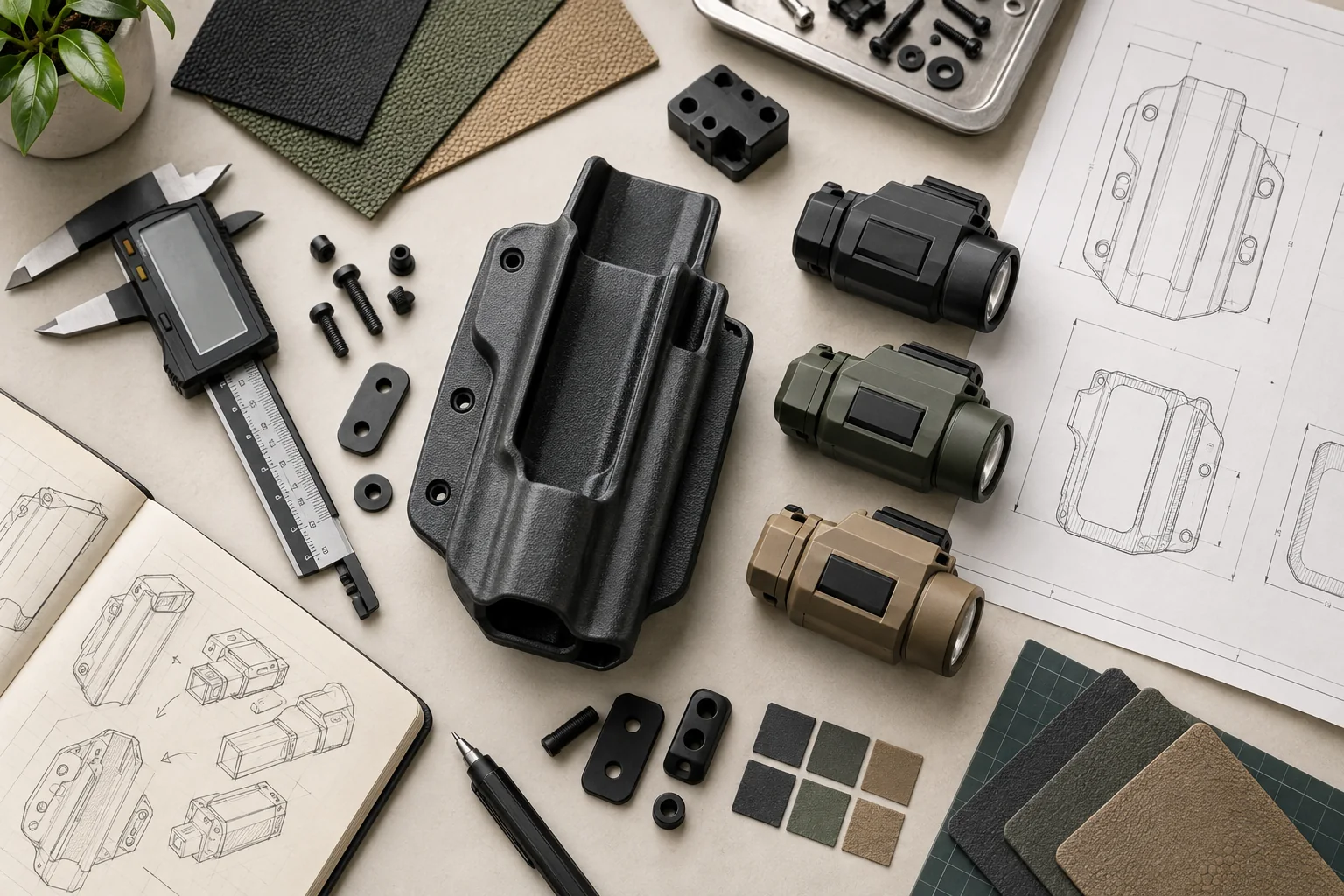
Why is the light part of the fit reference?
Two accessories with similar outside dimensions may use different mounting keys, switch shapes or positions relative to the host. Those differences can change the formed channel, retention contact and opening geometry. Model names alone are therefore not a controlled fit reference.
What belongs in the development brief?
| Input | Define | Verify on sample |
|---|---|---|
| Host configuration | Exact model, length and approved accessories | Seating and protected clearances |
| Light module | Model, mounting key, controls and position | No interference or unintended activation |
| Retention | Contact area and adjustment range | Repeatable insertion and removal |
| Opening | Coverage and dimensional limits | Required protection and unobstructed path |
| Attachment | Belt, paddle, MOLLE or platform interface | Stability and hardware clearance |
Control the complete configuration
Document every component that changes the envelope, including optional sights, adapters or alternate modules approved for the SKU. Treat substitutions as engineering changes until fit and function are rechecked. The released specification should identify handedness, ride position, cant range, sheet grade, nominal thickness and hardware stack.
How should the prototype be reviewed?
- Confirm full seating without forced interference.
- Check clearance around controls, fasteners and service points.
- Review retention throughout the approved adjustment range.
- Inspect formed-wall thinning and stress near openings and holes.
- Test the assembly on the intended belt or mounting platform.
- Record the exact reference configuration with the golden sample.
Continue with the golden-sample approval guide, hardware specification page, belt attachments and light-bearing OWB concept.
Frequently asked questions
Can one light-bearing shell fit several light models?
Only when the allowed configurations are explicitly designed and validated. Similar dimensions are not proof of compatibility.
Does the accessory alone control retention?
Not necessarily. The approved design may use several contact features; the retention method must be stated and tested rather than assumed.
Should a module substitution require approval?
Yes, when it changes the fit envelope, controls, mounting position or required clearances.
Define the exact light-bearing configuration before sampling.
Share the application, target quantity and launch requirements. We will outline the most practical sampling path.