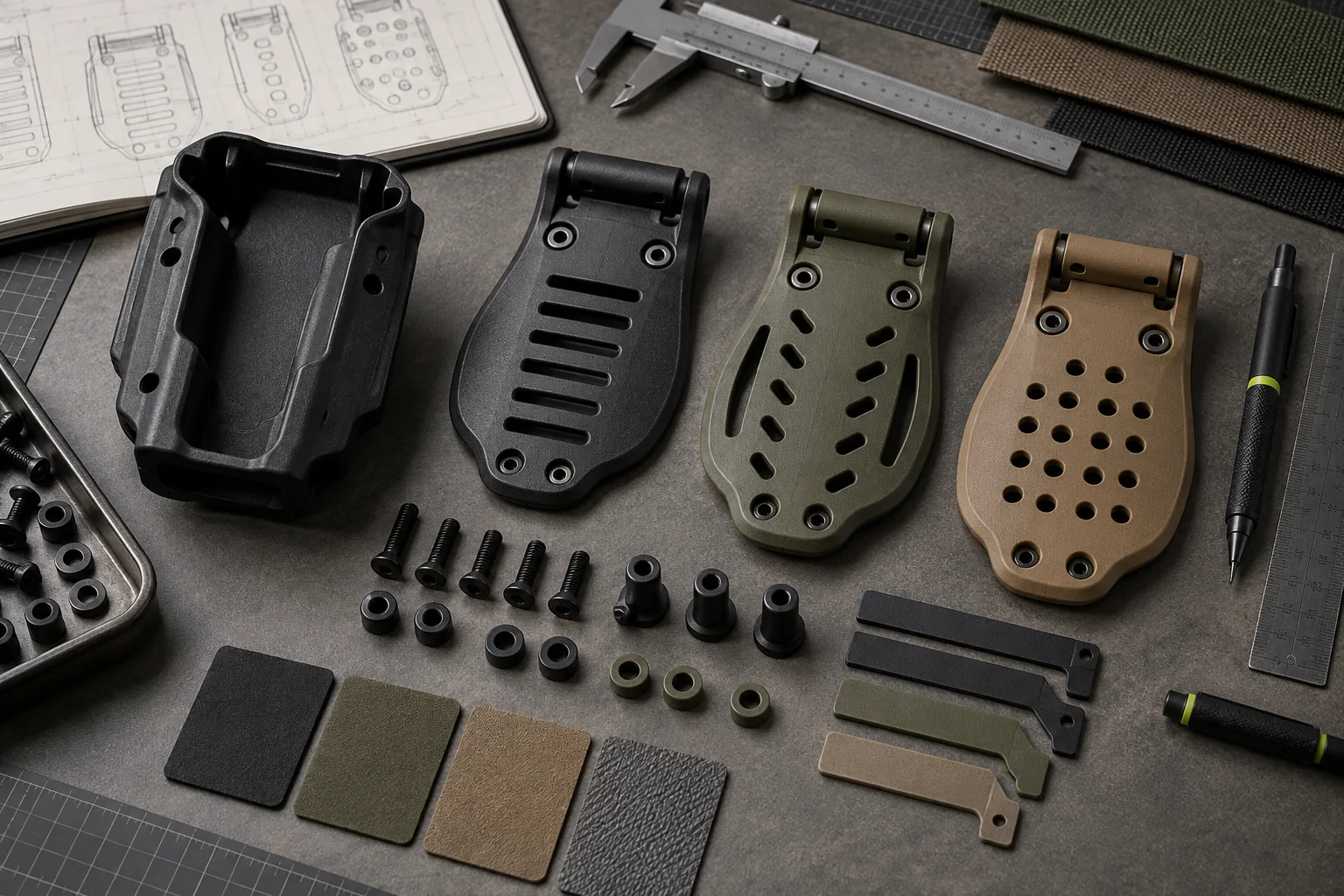
What should buyers define first?
State the intended belt-width and thickness range, carry position, permitted ride height and cant, whether installation and removal should require opening the belt, and the representative shell or carrier. These inputs shape the paddle more reliably than starting from a generic plate.
Which design variables interact?
| Variable | Why it matters | Approval evidence |
|---|---|---|
| Body-side contour | Controls contact area and installed angle | Representative wear-position review |
| Belt engagement | Resists lift and unintended release | Specified belt-range test |
| Hole pattern | Transfers load into the shell | Edge distance and fastener clearance |
| Ride and cant | Changes leverage and access | Every allowed mounting position |
| Material and ribs | Influence flex and shape recovery | Loaded inspection and cycle plan |
Why is the shell part of the test?
The same paddle can feel different when paired with shells of different height, width, mass or fastener spacing. Evaluate the final assembly rather than qualifying the attachment in isolation. Hardware length, spacer stack and thread-control method should be part of the released bill of materials.
How should a paddle prototype be reviewed?
- Install and remove it across the approved belt range.
- Check movement and edge contact in representative positions.
- Review fastener access and clearance to the carried item.
- Inspect flex, permanent deformation and attachment holes after cycling.
- Confirm every permitted ride-height and cant position.
- Retain the approved assembly as part of the golden-sample record.
Compare paddle OWB development, OWB product architectures, belt attachment families and retention hardware.
Frequently asked questions
Is a paddle attachment universal?
No. Belt range, contour, hole pattern, shell geometry and load must be defined for the approved assembly.
Can one paddle support adjustable cant?
It can when the hole pattern and permitted positions maintain strength, clearance and stable engagement.
Should the paddle be tested without a belt?
Bench checks are useful, but approval should include the intended belt range and complete mounted product.
Engineer the paddle around the real belt and shell.
Share the application, target quantity and launch requirements. We will outline the most practical sampling path.