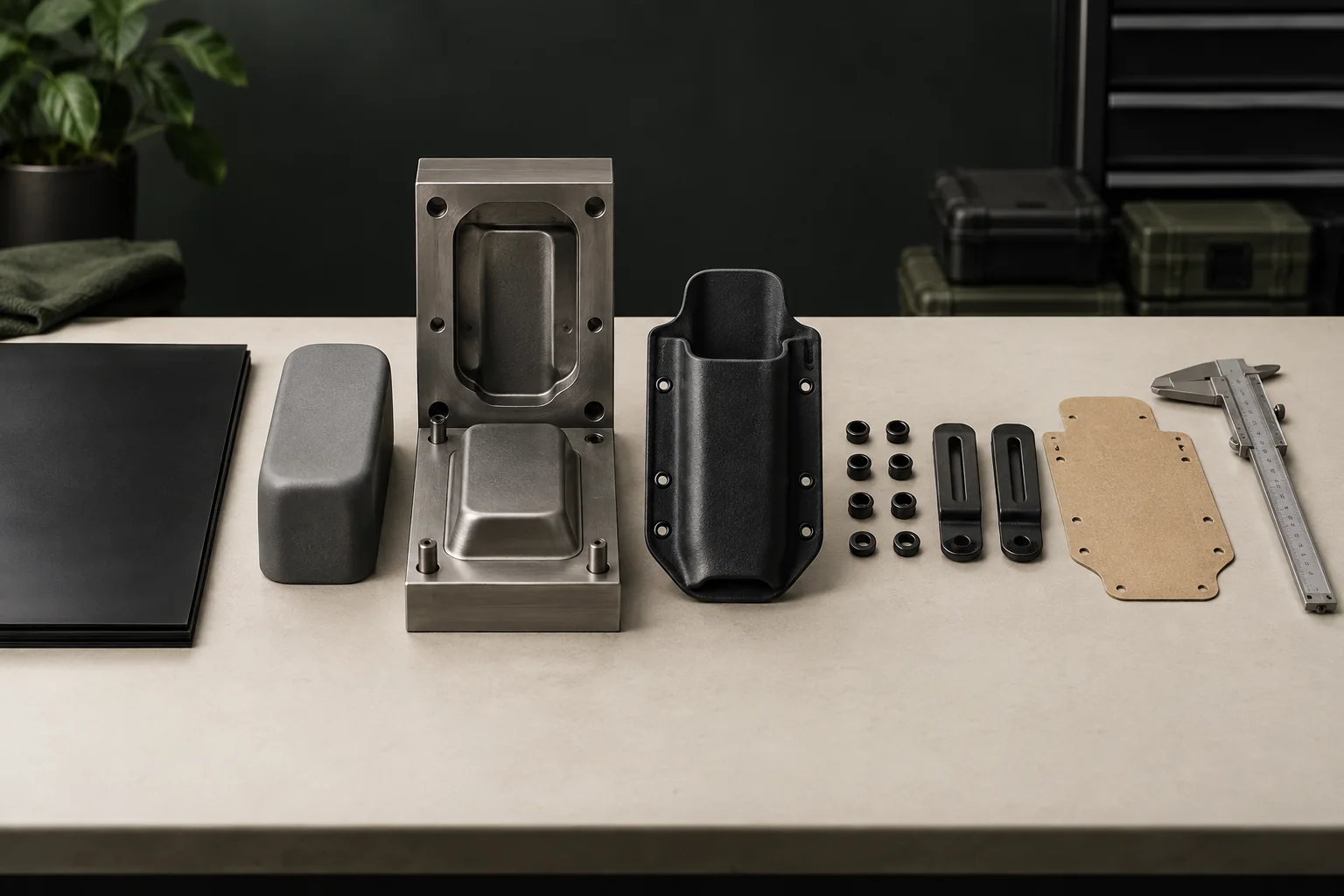
A KYDEX knife sheath is made by turning a verified knife or safe dimensional reference into controlled clearance, retention, edge, drainage, eyelet and mounting geometry. In OEM work, forming the shell is only one stage; the approved product also depends on trim, hardware, attachment and repeatable inspection.
What must be defined before making a KYDEX sheath?
The source geometry must identify the exact blade profile, handle transition, guard, thickness changes and any areas that must not bear load. A photograph is useful for context but cannot replace dimensions, a verified sample or controlled 3D data. The buyer should also state carry orientation, mounting interface, drainage, required access, intended retention behavior and replaceable hardware.
KYDEX knife-sheath manufacturing sequence
| Stage | Controlled decision | Buyer-visible evidence |
|---|---|---|
| 1. Reference intake | Identity, revision, contact and protected zones | Reference record or approved data |
| 2. Architecture | Folded or two-piece shell, eyelet line, opening and drainage | Concept drawing or prototype |
| 3. Material | Grade, gauge, color and texture | Material specification |
| 4. Forming | Heating readiness, tool contact, pressure/vacuum route and cooling | Process record and formed sample |
| 5. Trim and holes | Outline, edge clearance, eyelet pitch and mounting pattern | Released trim definition |
| 6. Assembly | Eyelets, posts, screws, spacers and attachment | Bill of materials and work instruction |
| 7. Validation | Insertion, withdrawal, retention, contact, mounting and appearance | First article and approved sample |
How is retention designed?
Retention is created by the released relationship between shell geometry and the reference object. It should be assessed together with insertion direction, withdrawal path, contact zones, temperature range, contamination, attachment stiffness and acceptable wear. A “tight” sample is not a complete retention specification. Buyers should define functional checks and reapproval triggers.
What is different about fixed-blade knife sheaths?
Searches for fixed blade knife sheath, knife sheath fixed blade and sheath fixed blade often describe the same broad product family. The actual design changes with blade length and thickness, guard geometry, handle access, carry angle and mounting environment. A custom fixed-blade sheath therefore needs a controlled reference rather than a generic size label.
Is this the same as a DIY KYDEX sheath tutorial?
No. DIY searches are useful evidence that people want to understand the process, but this article explains the OEM control sequence rather than giving a universal workshop recipe. Internet heating temperatures, press times or improvised tooling should not be copied into production without matching the exact sheet, equipment, part geometry and supplier guidance.
What should an OEM sheath RFQ include?
- Verified knife model, sample, drawing or 3D reference and revision.
- Folded or two-piece preference, access and retention expectations.
- Carry orientation, belt, MOLLE or other mounting interface.
- Material grade if specified, nominal gauge, color and texture.
- Logo or decoration location, included hardware and packaging structure.
- Prototype quantity, expected order volume and inspection requirements.
Frequently asked questions
Can one sheath fit several knife models?
Only when the relevant geometry and functional checks support it. Similar overall length does not prove identical guard, thickness, retention or contact behavior.
Should the sheath use a clip or eyelet platform?
That depends on carry direction, belt or MOLLE interface, adjustment needs and load path. The attachment and its fastener stack should be approved with the shell.
Why must formed edges be reviewed?
Trim shape and edge finish affect access, user-contact areas, stress concentration and appearance. They are controlled features, not cosmetic cleanup after forming.
When is a new sample required?
Revalidation may be needed after changes to the reference model, material, tooling, trim, holes, eyelets, attachment, hardware or functional criteria.
Review the custom knife sheath program, the design and mounting guide and the first-article checklist, then send the project through the RFQ.