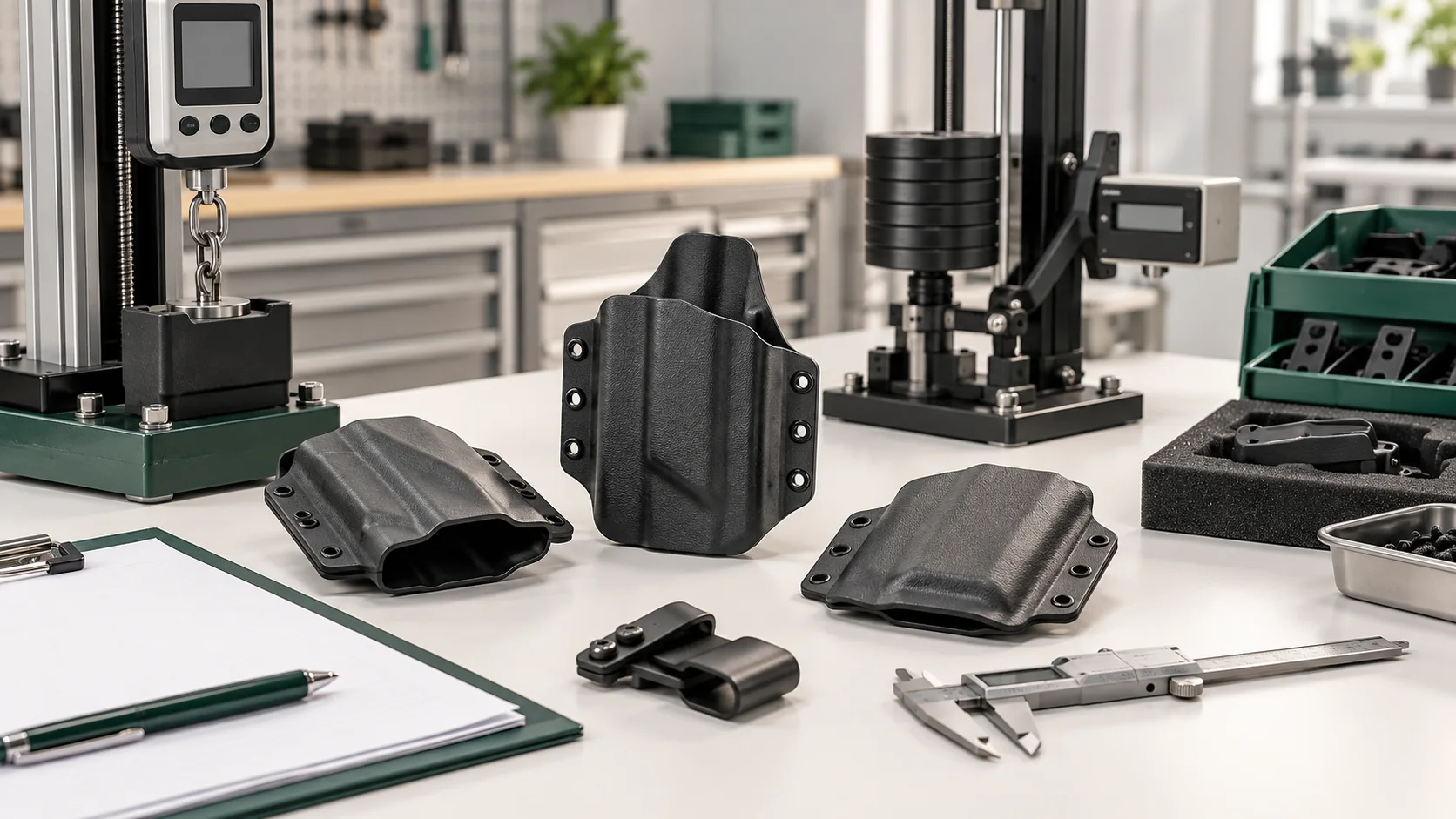
What is functional validation for a molded carry product?
Functional validation is the documented evidence that an approved configuration fits, retains, releases and mounts as intended. It connects buyer requirements to a repeatable check rather than relying on a subjective impression. For an OEM program, the validation unit should identify the shell revision, material, hardware stack, attachment, fit reference and test condition.
Which decisions belong in the validation plan?
| Decision | What the buyer defines | Useful evidence |
|---|---|---|
| Configuration | Exact fit reference, accessory state, shell and mounting revision | Controlled sample and configuration list |
| Retention | Direction, rate, conditioning and acceptable force window | Fixture method and recorded results |
| Release | Required user action and prohibited interference | Functional sequence check |
| Mounting | Belt, MOLLE, platform or fixed interface and load direction | Representative assembly test |
| Durability | Cycle count, inspection intervals and failure criteria | Pre/post measurements and defect record |
| Lot release | Sampling rule and response to a nonconforming result | Inspection plan and disposition record |
Why is “good retention” not a sufficient requirement?
Retention is influenced by geometry, hardware compression, spacers, material condition, mounting stiffness and the direction and rate of force. A verbal target cannot tell two inspectors how to reproduce the same result. Define a measurable window and pair it with functional observations such as full seating, predictable release and absence of damaging contact.
How should pull force be measured?
Use a controlled fixture that locates the product without artificially squeezing or spreading it. Identify the pull direction, attachment point, speed or method, number of repetitions, conditioning temperature and whether the mounting system is installed. The measurement should represent the use case without implying that one fixture result predicts every field condition. Record the gauge identity and sample revision with the result.
Does an inversion test prove product safety?
No. Inversion can be a quick screening check for a defined sample, but it does not quantify release force, dynamic movement, mounting security or active-retention operation. It should never be presented as a universal certification. Buyers should select checks from the intended application and risk assessment.
How are passive and active retention different?
Passive retention is created by formed geometry, friction or adjustable compression. Active retention adds a mechanism that requires a deliberate release action. Safariland explains that its named duty ratings use its own mechanisms and test procedure; those ratings are proprietary and should not be copied onto an unrelated OEM product. The manufacturer’s retention overview also illustrates why the complete holster, approved mount and belt matter to a claimed rating.
What does the NIJ retention work tell OEM buyers?
The US National Institute of Justice’s duty-holster retention fact sheet identifies form and fit, performance, testing, documentation and labeling as separate elements, and distinguishes continuous from instantaneous forces. It does not make every commercial holster NIJ compliant. CarryMold does not claim certification through this guide; the source supports the principle that a retention claim needs a defined test and scope.
What should cycle testing examine?
A cycle plan can reveal drift in retention, loosening hardware, wear at contact zones, cracking near holes, mounting movement and changes in release behavior. Define the representative action, inspection intervals, hardware adjustment policy and stop criteria before testing. If hardware is re-tightened during the test, record when and why. Review the hardware and fastener-stack guide when the assembly uses screws, posts, washers or spacers.
How should mounting be included?
Test the product with the intended belt attachment, MOLLE interface or platform because the mount changes stiffness and load paths. Check fastener seating, slot condition, edge clearance and movement under the agreed directions. A strong shell paired with an unsuitable interface is not a validated carry system.
How should lot sampling be selected?
Sampling must be agreed rather than inferred from a percentage copied online. ISO 28590 introduces the ISO 2859 family and explains that different sampling systems suit different situations. An isolated pilot lot and a continuing series of repeat orders may need different plans. The buyer and supplier should define lot identity, inspection level, acceptance rule and disposition before shipment.
What belongs in the approved release package?
Include the requirement table, configured bill of materials, drawing revision, fixture or method, conditioned sample state, results, approved deviations and identified physical sample. Link this evidence to the first-article inspection and golden sample. The sample interprets tactile behavior; it does not replace the written method.
When is revalidation needed?
Consider revalidation after changes to fit reference, shell geometry, material grade or gauge, forming tool, trim, retention hardware, attachment, assembly torque method or approved supplier. Use the OEM manufacturing workflow to identify which evidence must be repeated rather than automatically repeating every test.
What should a buyer send for quotation?
Send the application, exact fit configuration, mounting route, desired retention behavior, target market, expected quantity, known standards, proposed checks and launch timing through the RFQ. CarryMold can then separate feasibility questions from quote-specific validation commitments.
Frequently asked questions
Does CarryMold publish one standard pull-force value?
No. Geometry, mounting and application differ, so the acceptable window must be agreed for the quoted configuration.
Can a branded retention level be transferred to another holster?
No. A rating belongs to the owner’s defined mechanism, product configuration and test procedure unless an authorized standard says otherwise.
Should every production unit receive destructive testing?
No. Separate nondestructive unit checks, sampled functional checks and destructive qualification tests in the control plan.
Can a golden sample replace test records?
No. It is a valuable tactile reference, but repeat production also needs an identified method, acceptance rule and result record.
Define retention evidence before the sample becomes the standard.
Share the application, target quantity and launch requirements. We will outline the most practical sampling path.