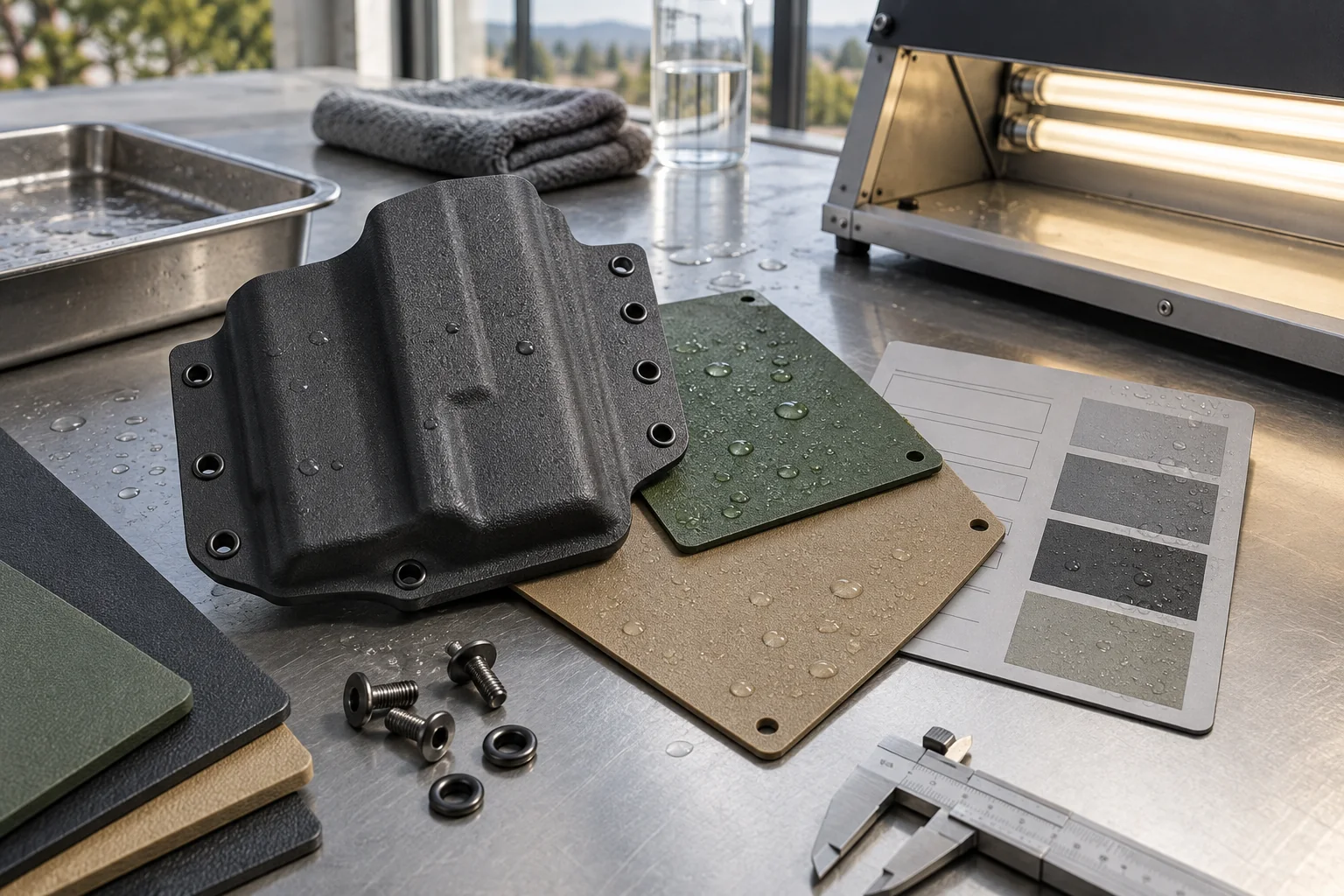
Is standard KYDEX sheet UV resistant?
SEKISUI KYDEX states in its product FAQ that most KYDEX sheet products are not UV resistant and recommends protection or a grade intended for outdoor exposure. The manufacturer separately describes KYDEX 1100UV as a weatherable grade recognized to UL 746C (f1) for UV exposure and water immersion. These statements show why a buyer must name the exact grade; they do not establish that any one grade is automatically suitable for a particular carrier.
What environmental information belongs in the brief?
| Exposure | Define before quotation | Evidence or validation to request |
|---|---|---|
| Sunlight and UV | Outdoor duration, geography, storage and acceptable color change | Grade-specific weatherability data and formed-part exposure plan |
| Temperature | Service, vehicle-storage and shipping extremes plus applied load | Relevant material data and conditioned fit/retention checks |
| Water and humidity | Rain, immersion, drying, drainage and trapped moisture | Assembly review including edges, eyelets, fasteners and backing |
| Chemicals and cleaners | Named products, concentration, contact time and cleaning method | Manufacturer resistance data plus finish and hardware checks |
| Abrasion and contamination | Dust, grit, repeated insertion and cleaning frequency | Wear-cycle inspection at fit, edge and retention contact areas |
Why must the complete assembly be evaluated?
The sheet is only one part of the product. Water can remain around eyelets, spacers or textile backing; thermal movement can affect fastener clamp-up; contamination can change sliding or retention behavior; and the mounted carrier can see leverage that a flat material coupon does not. Test the approved shell, hardware, adapter and representative host platform together.
How should chemical resistance be specified?
SEKISUI KYDEX publishes a chemical-resistance technical brief showing that results vary by chemical and condition. A general claim such as “chemical resistant” is not a cleaning specification. Name the expected cleaner, oil, fuel or other substance, together with concentration, temperature, contact time and acceptable visual or functional change.
Buyer release checklist
- Record manufacturer, exact sheet grade, nominal thickness, color and texture in the bill of materials.
- Define outdoor, vehicle, warehouse and transport exposure separately.
- Identify acceptable color, gloss, dimensional, fit and retention change.
- Include hardware, backing, labels and mounting interfaces in the evaluation.
- Condition and inspect a representative formed assembly, not only a flat coupon.
- Connect the approved evidence to the golden sample and change-control process.
Use CarryMold’s materials and textures page, sheet sourcing guide, equipment-carrier family, mounting-system family and quality-control framework to build the RFQ. Any material substitution should return through the golden-sample approval process.
Frequently asked questions
Does black KYDEX automatically resist UV exposure?
No. Color alone does not identify the sheet grade or its documented weatherability. Request the manufacturer and exact grade.
Is a material datasheet enough to approve an outdoor carrier?
No. Datasheets support selection, but the formed and assembled product still needs application-specific checks under the intended exposure and load.
Should vehicle storage be included in the specification?
Yes when it is foreseeable. State the storage condition, duration and loaded configuration, then define the fit, retention, appearance and dimensional checks required afterward.
Define the environment before selecting the sheet grade.
Share the application, target quantity and launch requirements. We will outline the most practical sampling path.